Wednesday, September 15, 2010

All good things must come to an end

All good things must come to an end

We often hate to use clichés but, as it turns out, our time with the Peace Corps has been a good experience, and, moreover, it has come to end, so what better way of phrasing that than the tried and true. Ok, so you get the picture. Our two years with the Peace Corps have finally wrapped up and we´re enjoying some time in the States before heading to Nicaragua and Ecuador for one final hoorah before heading home in December to begin looking for work and then preparing for grad school (Emily). For those loyal few who´ve read a lot of what we´ve written over the past two years, thanks for your interest, and we hope this last entry will be an interesting way to end the saga.

Teaching


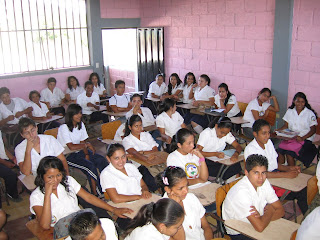
Dan teaching a class of eigth graders


We wrapped up our time with the Peace Corps by teaching a great deal of both English and civic education courses. With regard to English, each of us was occupied between 4 and 5 nights a week teaching English to many motivated teens and young adults who are in the process of completing their 7th, 8th, and 9th grade educations respectively. At the end of the school year, after all of the exams were graded, projects returned, etc. we were treated to a “gran despedida”, or “great farewell party”, by our students at each of the two schools where we taught English. We received nice gifts, ranging from wood carvings, to ornate key holders, to a nice collared dress shirt. Naturally, the food we received was also quite scrumptious and we did nothing short of stuff ourselves on shish kabobs, rice, beans, tortillas, and two types of cake (one of which Emily had painstakingly prepared the night before, the other of which our students prepared for us). We hope that our students improved their ability to speak and write English, and above all else to better comprehend both written and spoken English. Regardless of our students individual aspirations, we´ve learned over the past two years that having some grasp on English is very advantageous to obtaining many of the more professional and lucrative jobs in the country. We were very proud of our student´s progress and dedication and we wish them all the best!


Emily with her students at La Gran Despedida


Our second year of civic education via what is known as Project Citizen was a wonderful experience, and arguably one of our proudest achievements during our two years in Honduras. Do you want to know the best part? We became more and more expendable as time went on and as our counterpart – already a fantastic local civics teacher – developed more confidence with her ability to teach the program. So, for a quick explanation of what´s involved in Project Citizen, let us phrase it this way: Project Citizen is a program designed to teach students the philosophy behind community development while also providing them with multiple tools to enhance their individual and collective capacity to be local change agents. Hmm, there must be a less, how to put it, stuffy rhetoric to describe Project Citizen. More than anything, it´s intended to get kids involved in changing their community for the better by identifying problems via community surveys and then conducting legitimate research to help propose viable solutions to those problems. We were thrilled by the problems our students chose to address (excessive vehicle speed on a road adjacent to their school, problems with the functioning and location of localcanteens , the need for a bridge to span a creek that often becomes an impassable river for students and other residents during the rainy season, improving public lighting in the neighborhood, and improving a local soccer field), and, moreover, by their success in proposing creative and convincing solutions for dealing with those problems. Our counterpart teacher at the school plans to create a conference in our town to teach other area civics teachers the fundamentals of Project Citizen, so as to pay it forward. With these students we were again treated to a very nice despedida, but this time we only had to worry about cake. Phew!


Our students outlining the need for new traffic safety measures


Libraries

The many generous people who donated books to our book drive will be pleased to know that dozens of kindergarteners and school aged kids have already enjoyed many of the wonderful stories you´ve sent their way. Several kids have even developed favorites and have taken to asking their teacher or librarian to read them the story once again. In total, books were donated to four locations (one kindergarten, one elementary school, one small-scale community library, and one other traditional school covering from first through ninth grades). Three of those locations have already begun to use the books – two of them very extensively – and the fourth location has plans to make the books accessible to students in the very near future once they´ve constructed shelving to house them all. It has been truly inspiring to see the children excitedly opening the books and to hear stories from their teachers about how much enthusiasm they´ve shown towards reading. To the many of you who donated to our book drive, thanks once more for all of your generosity! It will undoubtedly pay dividends for the years and decades to come.

Saying goodbye

As you´ve seen woven into the few paragraphs written above, we said a lot of goodbyes as we prepared to leave Honduras. Certainly there were rough patches in our service, but such is life. At the end of the day we´re quite pleased to have volunteered with the Peace Corps, not so much for the positive impact we´ve made in the lives of others, but rather for the experience as a whole, which has been one of teaching and learning, speaking and listening, becoming better acquainted with our town and the country as a whole, and ultimately learning to be more empathetic with regard to the challenges many Hondurans face when trying to make a better life for themselves, their families, and their country as a whole. We hope to keep in touch with the friends who most inspired us to see what they achieve as time goes on. That´s it. İAdios Peace Corps and adios Honduras!

Enjoying our local outdoor market, from which we bought most of our produce

Thursday, April 8, 2010

La Moskitia

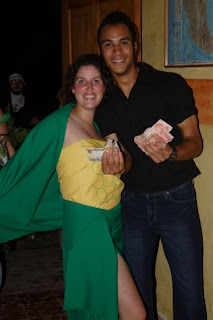
This year, for Semana Santa (Holy week) – which much more closely resembles Spring Break in Honduras than a religious holiday – we decided to travel to La Moskitia with six other Peace Corps volunteers. La Moskitia, also spelled Mosquitia, is the largest swath of rainforest north of the Amazon and home to three distinct indigenous groups as well as flora and fauna not found elsewhere in Honduras. Because La Moskitia is so remote, and once there the only form of travel is via boat, we used the NGO La Ruta Moskitia to plan our trip. La Ruta Moskitia plans the travel logistics, but the money all goes to the local communities through envelopes of lempiras that we carried along with us.

Thursday, 25 March 2010
We all arrived in La Ceiba from our different sites and received a briefing from La Ruta Moskitia about our trip starting early the following morning.

Friday, 26 March 2010
At 4:00 am our alarm went off so that we could get to the airport by 5:00. At 6:10, our little 16-seater plane took off from the La Ceiba airport for our 50 minute flight to Brus Laguna. The small plane did not have a pressurized cabin and when we took off, the pilots had windows open in the cockpit. We landed on a dirt runway in Brus Laguna and were met by the coordinator of la Ruta Moskitia to take us to breakfast. Breakfast consisted of beans, cheese, a fried egg, flour tortillas, hot dogs pretending to be sausage, and coffee. Corn tortillas are commonly eaten throughout most of Honduras, but along the Caribbean coast, flour tortillas reign.


We took a quick tour of Brus Laguna, the last town of any size we were to see in La Moskitia, before heading upriver. From this point onward, all our travel was in pipantes (dugout canoes), some of which were motorized, others of which were powered by paddle and pole. Our trip upriver took about an hour and a half and along the way, we saw water buffalo (an introduced species that has thrived since its introduction), a small turtle, and Jabiru, a giant prehistoric-looking bird that stands over four feet tall.

We arrived at the Yamari Savanna Cabanas, which were wooden cabins on 6 foot tall stilts with thatched roofs. The cabins were surrounded by grassland, which is not what one typically imagines when thinking of La Moskitia, and there was neither a road nor visible signs of other people (we were told that a community lies just a few kilometers from where we stayed). A quick bathroom break presented another surprise; we discovered that frogs live along the rim of the toilet and are washed into the bowl by the rush of water every time someone flushed, only to scramble back up the slippery porcelain into their nook.


After a quick swim, we had a lunch of fish in coconut milk, rice, and salad. We went on a short hike in the afternoon and saw a scarlet tanager and a tarantula in its hole. After dinner, we got back into the pipante to look for caiman and crocodiles. Drifting downstream in our boat, we shone our headlamps about until spotting the glowing eyes of a crocodile. We saw three crocodiles between 3 and 5 feet long and the guide caught a baby croc for us to hold. After our nighttime adventure, we were ready for our first good night’s sleep in days and were rocked to sleep by the cabin as it swayed gently in the wind.

The Scarlet Tanager
Baby crocodile
Saturday, 27 March 2010
Breakfast consisted of warm milk and corn flakes (a preference many Hondurans still maintain from the days of pasteurizing milk by bringing it to a boil), pan de coco (bread made using coconut oil), honey, and eggs. Unfortunately, I (Emily) was feeling a bit under the weather, with what we later decided was a 24 hour bug, so I only stomached a couple of bites of bread, which I shortly thereafter threw up off the balcony of our cabin.

We had a four and a half hour trip to the community of Rais Ta. These long boat trips were beautiful but tiring due to the hours of sun exposure. We were constantly passing sunscreen up and down the boat. For lunch, we had rice, meat with gravy, whole beans, and boiled mature plantains. I stuck with the rice as my stomach was still not up to most foods. While I took a nap, everyone else went on a community tour and learned about the risky deep-water diving for lobster that provides an income for many in the community. After dinner, we attended a cultural night of traditional Miskito dances. The despedida (or farewell) dance was one in which we made a tunnel of arms and each couple repeatedly took their turn passing under the arms and becoming the end of the tunnel until we’d traced a perimeter around all of our cabins and returned to the bonfire for a final goodbye.


The sopilote (vulture) dance

Sunday, 28 March 2010
While I was feeling significantly better and finally up to eating, Nathan was getting sick. We decided that what was going around was probably viral, and since Nathan and I had sat next to each other on the boat the day before, we decided to “quarantine” us for the day. He and I sat in the back of the boat with Ana and Daniel as a buffer to keep the rest of the crew from getting sick. It seems to have worked because the bug stopped with Nathan.

We had a three hour boat trip up the Río Plátano (Plantain River) until our stop for a lunch of rice, chicken, mashed potatoes, pan de coco, and coconut water. Then we traveled for another three hours before reaching the community of Las Marias. Along the way, we saw an otter, a crocodile and a guacamaya/macaw (the national bird of Honduras). Our cabin in Las Marias was more rustic than the places we had stayed before and privacy was a bit harder to come by. Our room, for example, didn’t have any curtains, so we hung towels and sheets over the windows.


Lunch time!

Monday, 29 March 2010
We arose early for our daytrip to the petroglyphs. Two of us sat in each pipante, which were propelled upstream by two people with long poles in the front and one person using a paddle as a rudder in the back. The two in front, working together with the same rhythm, drove their poles down to the rocky bottom of the river and pushed the boat upriver. Miskito children learn from a very young age how to guide a pipante, and had we tried, we surely would have capsized the boat!


We hiked with our guide, Ezekiel, through primary rain forest and saw many medicinal plants as well as stunning vistas. After the hike and a quick lunch, the pipantes took us the rest of the way to the petroglyps. The age of the petroglyps is unknown (estimates range from 1000 to 3000 years old), but regardless of the ambiguity about their age they’ve been declared a world heritage site. Many believe the carving to be two crocodile heads facing in opposite directions. After a lovely swim next to the petroglyps, we headed back downriver. We were all ready for a shower after a long day of swimming, hiking and sweating in the sun. The shower at Las Marias was also not very private. It was a large roof-less porch constructed of wooden boards with a curtain for a door (which often blew open). We used a bucket to pour water over our bodies and the water simply flowed through the gaps in the floorboards and onto the ground 6 feet below. Although the shower was less private than what we’re used to, there were beautiful views of the river and jungle from inside.

Tuesday, 30 March 2010
Today we started our three-day hike up Pico Dama. After a short hike to the pipantes, we traveled upriver for a couple of hours. Along the way, we saw tucans, 4 macaws, and our guides stopped to harvest some yucca, which is the monstrous root structure of an unsuspecting small tree. Then we had a hard two and a half hour trip up to the cabin. We hiked through primary rainforest and Eva, our guide, taught us how to drink water out of a vine. The cabin where we stayed was also on stilts, and Eva made a fire underneath to cook dinner. Because of this arrangement, by the end of the trip, all of our clothing smelled of campfire smoke. After a dinner of yucca, spaghetti, beans, rice, and coffee, we all headed for bed early. With no light other than our headlamps and the fire, plus being tired from our arduous hike, we went to bed shortly after the sun set at 6:30.

Wednesday, 31 March 2010
At 5:45 we got up to summit Pico Dama, so we would have a greater chance of seeing wildlife in the early morning. The latrine was out of order, so for our morning bathroom break, we dug a hole with the machete. After a breakfast of fried tortillas and oatmeal, we started our hike. We came across a group of about 6 toucans, which, in the round, made a considerable amount of noise with their beaks. Later, Eva pointed out to us a tapir footprint in the mud.

Our hike included climbing up massive tree roots through an incredibly lush jungle. There was moss everywhere and moisture dripping from the leaves. We reached two beautiful viewing points from which we could see the community of Las Marias far downriver.

After lunch and a nap, Kevin came with news that he had seen monkeys just five minutes from camp, so we all rushed off to see the monkeys. Although we had been careful throughout our trip in the jungle to wear long pants and shoes, in our excitement about the monkeys many of us were wearing shorts and sandals. We did come across the spider monkey who was swinging through the trees. However, shortly thereafter, six of us walked past the barba amarilla (or fer-de-lance), the most poisonous snake in this region of the Americas, without noticing it. Eva told us that a bite from a barba amarilla can kill someone within 20 minutes if they do not receive medicinal plants and proper medical attention. We were very fortunate that the snake didn’t bite any of us and attribute our luck to having been quite boisterous as we walked through the woods (a surprised snake is much more likely to strike – out of fear – than one that can anticipate your presence; for that reason, when in snake country, it's often recommended to hike with a sturdy walking stick and plant it firmly on the ground while walking so as to send warning vibrations to any snakes in the area).

Thursday, 1 April 2010
It was raining hard for our nearly two hour hike down from the cabin, so we slipped and slid through the mud, most of us falling at least once. Along the way, Eva pointed out several medicinal plants for everything from bed wetting to menstrual pains to birth control. We saw a white-faced monkey as well, so of the three types of monkeys found in La Moskitia, we saw white-faced and spider monkeys and heard howler monkeys. The unique hike up Pico Dama was the highlight of the trip.


Pico Dama


For the pipante ride downstream, our guides used paddles instead of the poles. Once back in Las Marias, it was time for a shower and tick check. Shannon and I tied for the most ticks with nine each.

Friday, 2 April 2010
After a breakfast of oatmeal and fry bread, it was time for our four and a half hour trip back downriver to the community of Belén, which is along the Caribbean coast. Once there, we had a lunch of soup with coconut broth, plantains and yucca, as well as some fish.

We then went to learn how to fish in the ocean. We were given some fishing line wrapped around a coke bottle or a bit of wood with a hook on the end. We used red worms and then stood waist deep in the surf to try to catch a fish. Due to stormy weather, the surf was larger than normal, so our guides didn’t have much faith that we’d catch anything. The waves reminded me of Cannon Beach, which was surprising for the Caribbean. In over an hour of fishing, only Ana caught a fish, and although small, it was a stunning white. For dinner, we ate refried beans, fried egg, cheese, tajadas (fried green plantains), and Ana’s fish.

Saturday, 3 April 2010
Our last day was dedicated to traveling by land out of La Moskitia. At 3:30 a.m., we got in the boat for a nearly two hour ride. None of the communities where we had stayed had electricity, but as we moved closer to civilization, we saw more and more lights on the docks in the early-morning darkness.

We arrived in Batalla, where there were pickup trucks waiting to take passengers to Tocoa. Because there is still no road for a while, buses cannot run this route, so pickups are the mass-transit option. There were 14 of us crammed into the bed of the truck, which made for a less-than-luxurious ride. We drove along the beach, often in the water, for nearly two hours before hitting the dirt road upon which we traveled for another two and a half hours. By the time we were done, we were covered in dust, which stuck to our sunscreen and made us truly filthy.


The "road" to Tocoa


Once in Tocoa, we still needed to get to La Ceiba, where we were spending the night. We got a jalón (hitchhike ride) in the back of a pickup going to La Ceiba, which although free and faster than the bus, meant another couple hours of wind, sun, and dust. By the time we got to our hotel (a quaint little place named Casa Roselyn that’s located outside of town and owned by a young Honduran-Swiss couple), we were ready to relax and not be traveling for a little while. Swimming in the pool, which is filled with mountain runoff, felt amazing after all those hours in a pickup.

Sunday, 4 April 2010
We caught the 6:15 bus out of La Ceiba (for which we had bought tickets 10 days in advance in anticipation of the heavy traffic of thousands of people traveling home from Semana Santa) and were back in Siguatepeque by 11 a.m. Thus ended our adventure in La Moskitia.

Urban Design and English

Urban Design and English

Well, although brief, we would like to share a bit about some of our most recent work efforts. Four nights a week we continue with our efforts as English teachers as part of a program designed to offer the equivalency of middle school classes to people who otherwise wouldn’t have the opportunity to continue their education. It's satisfying to know that we’re supporting a population that would otherwise be marginalized from the education system. It's also a challenging, albeit satisfying environment in which to work as we have students ranging from their early teens to early-mid adulthood within the same classroom.

Interior view of the building complex from an aerial view

The other project we’ve recently had a chance to work on was one of urban design. A neighborhood in which we’ve done a fair bit of work off and on for the past year contacted me (Dan) to help with a preliminary design for a community building complex that they hope to begin raising funds for in the next few years. The building complex, which will likely encompass a computer center/library, small health center, community meeting hall, and technical high school, is an ambitious but worthy challenge for this neighborhood, which has a reputation for taking on large challenges and completing them with a strong sense of collaboration. Through a series of three brief, albeit productive meetings spanning only a month’s time, I was able to present the neighborhood with a few initial designs that they can use to inform the conversations and planning sessions they’ll undertake upon hiring someone to complete for them a final design preceding construction.

We’ll keep you updated as we along with several community members complete the long anticipated inauguration of a local school library in the next few weeks. We also hope to continue with our work as English teachers and will also soon be starting another year of Project Citizen (civic education) classes with a wonderful local high school teacher with whom we worked last year. Until next time, best wishes!

Side view of the far right side of the complex. This is where the technical high school is proposed to be built

Friday, March 12, 2010

Luz, Lucero, and a decidedly positive busyness

Luz, Lucero, and a decidedly positive busyness

Many of you will have already heard us speak about Luz, our kitten, who is quickly becoming a cat – if not in size then at least in attitude. We’ve already had her for nearly nine months and she’ll soon be completing her first year as of some time in April. Admittedly, this blog is not intended for telling stories about our cat (although, of course, we are fond of her) but rather to our overall experience as Peace Corps volunteers in Honduras. However, in the nature of sharing with you a bit about our lives here, let us share with you an anecdote about none other than Luz.

In most parts of the United States it’s commonplace to have a pet spayed as a young animal. Because we hope to bring Luz back to the States with us, and also as a general measure toward her long-term health, we decided to have her spayed here in Honduras while she’s still young. We’re fortunate enough to have a competent veterinary here in our town that does the surgery for 3,500 Lempira, which translates to about $175 USD. That’s not a tremendously high price to pay, but considering that our daily wages apiece are 170 Lempira (following that same 20 to 1 approximate conversion, that’s about $8 USD) it does take a bit of deliberate saving to afford such an operation. Largely because of that relatively high price, it is not at all common to spay or neuter an animal here – it’s a custom mostly reserved to the wealthier strata of society who see their animals principally as pets (i.e. nice animals to be nurtured) as opposed to mice chasers in the case of cats, human chasers as is the case for dogs, etc. It’s a done deal, though. For about two-thirds of one of our monthly salaries, Luz was spayed and is now well on her way to being a happy, healthy, kitten-less kitty.


A nice cat´s eye view

In the context of spending money on our cat, and in the broader context of comparing our lifestyles as volunteers with those of our Honduran peers, a few important details surface. One of our old neighbors (we’ve since moved to a slightly nicer, albeit still humble home) earned about 5,000 Lempira ($250 USD) monthly as a mason, which was slightly supplemented by his wife who worked as a cleaning woman. That 5,000 Lempira wasn’t too poor a salary in comparison with many others in the area, and on that salary not only he and his wife, but also their two children were dependent for all necessities.

As mentioned explicitly in a previous blog, and interspersed subtly throughout many others, as Peace Corps volunteers we live a simple life and strive to live as close to local norms as possible. Just to share a few examples, we travel by foot nearly any time we’re traveling within a 5 mile radius of our home, do a large portion of our shopping at the standard open air market in town, dress in humble clothing, and typically eat at home. Most of this we do with great pleasure (for those of you who know us, you already know how much we appreciate exercise, a humble presentation of ourselves, and eating simply), but for those things that we do with great relish along with those which we do grudgingly, our primary focus is that we maintain a sustainable standard of living according to local norms.

It is, however, only fair that we acknowledge the great differences in vulnerability and privilege between the humble lives we lead and those of our Honduran peers. When we get sick, are injured, etc. we’re entitled to the best medical care available (including, if necessary, being sent to specialists in Panama or Washington D.C.). To look at a broader trajectory of our lives, when we’ve completed our 27-month commitment with the Peace Corps, most of us have promising professional opportunities to explore, a more secure society to return to (for instance, remember that coups about 9 months ago?), and in general a more privileged lifestyle according to most indicators social scientists might employ to make such a determination. All of this is to say, try as we might to be humble and to walk in the shoes of the average Honduran, we are still foreign volunteers and do ultimately live a more privileged lifestyle, as does our cat as compared to her cat peers.

On to Lucero. In the past several months we’ve befriended a local horse, who we fondly named Claudia. At least once a week, we feed her carrots purchased from our local market, pet her a bit, and brush the flies away from her eyes. Claudia is a brown and white painted horse and is certainly one of the highlights of our walk into town. By speaking with a young boy who tends her along with about a dozen cattle, we’ve recently learned that she’s about 4 years old. When asking the boy about her age, we also had the surprise of learning that she has a name, and that it’s different than what we’d named her. Have we ever mentioned that here, as foreign volunteers, we sometimes find ourselves being thrust back into our childhood, if not toddler years? What we mean to say is that there are experiences one has as a volunteer abroad that force her to try to interpret her surroundings and come to conclusions without all of the relevant information that would otherwise be available in her home environment. So, yes, we assumed that Claudia didn’t have a name (she’s a horse, after all, and let’s remember that animals are typically first and foremost animals here) and provided her with a name that we thought was fitting, if not a bit presumptuous for a horse.


Enjoying a mid-afternoon snack


Well, as it turns out, her real name, Lucero, is quite fitting for her. She’s a beautiful horse, is quite affectionate, and her name means brilliant star. We now call her Lucero Claudia. That makes her name seem a bit more authentic, anyhow. In the Spanish tradition, many people have two first names and it’s customary that everyone have two last names, the first of which represents the father’s side of the family and the second of which represents the mother’s. If in the spirit of providing a simple illustration you’ll take a leap with us for a moment and consider that Lucero were a person, and take another even greater leap and consider that she were our child (we provide this example with the all important caveat that we are NOT at all yet interested in having children, nor a horse for that matter), her name would be Lucero Claudia Keller Casey.

Lucero has always been a bit healthier looking than most of her peers. She has a large pasture in which to graze and is obviously well groomed by her owner. She always seemed a bit too healthy, though, and as a result we’d often said (largely in jest) that perhaps she was pregnant. However, not having known her for more than 6 months, and not knowing how long the gestation period is for horses (we’re now pretty sure it's about 9 months) we really had no idea whether her large girth was normal or a sign of pregnancy. The birth of her filly five days ago, however, was the ultimate proof (unfortunately, we were not there for the birth). We’re not yet sure what to name her, but we’re certainly accepting suggestions. It's probably true that she already has a name, but that won’t deter us – she’ll just have one more. As a final side note, in case you like horses and want a few more details on the birth (we certainly hope you can at least tolerate horses, otherwise this must be an insufferable story for you), the filly has been running, if not sprinting, since day one, probably weighs near 80-100 lbs. and, per the local custom, has a red ribbon tied round her neck (yes, she’s everything that we think of when using the word “adorable”).


Also enjoying a mid-afternoon snack

As for the busyness, well, we’ve been pretty busy of late. Since the start of the school year about a month ago, we’ve been teaching English with a night school program, have made solid plans with a local school to open a library and have a young student or two trained to function as part-time librarian (thanks once more to those of you who so generously donated books for this project!), have begun to make plans for co-teaching a civics class with a local teacher, and have contributed to a preliminary plan for a series of community facilities to be built in a local neighborhood.

We imagine that our next blog will be filled with more details on these various projects as they come to fruition. In the meantime, thank you, as always, for taking an interest in our goings on. Don’t hesitate to email us (eckeller1@gmail.com, danielkeller1@gmail.com) or post comments to the blog if you have any questions, curiosities, name suggestions for the filly, etc. Otherwise, take care and here’s to wishing you all the best from Honduras!

Tuesday, January 5, 2010

The Rainy Day Good News

The Rainy Day Good News

As I'm fond of hearing John Lennon say around this time of year, another year is over and a new one just begun. Aside from being a fan of the man’s music, I like the song because it reminds me to begin the new year with a sense of optimism. This time around it is particularly nice to hear those words – new year. While I am going to talk politics for a brief moment, don’t worry, this isn’t destined to be another exposé on the political goings on of Honduras. Suffice it to say that last year was a pretty miserable year for almost all of Honduras (a perfect storm of political and economic upheaval that went a long way toward paralyzing the country) and the prospect of starting over again, albeit largely in a symbolic sense, is encouraging.

Better yet, there are also practical gains to be made in the near future. First of all, a new president will take office by the end of January, helping reestablish many economic and diplomatic ties that were severed between Honduras and other nations in the wake of the June 28th coup. The year 2010 will also bring Honduras its first birth in the World Cup since 1982. For a country this soccer crazed, qualifying for the World Cup is always a big deal, but this year’s Cup promises to be an event of national importance with few parallels in the nation’s history given the timing; soccer is the common man’s politics, leaving no room for empty public posturing, back room reciprocity, reneging on promises or any of the other man-inflicted plagues Honduras knows with such painful intimacy. Nope, in soccer you just go out and play, and if you’re corrupt, foolish or lazy and happen to be on Honduras’ national team, tens of thousands of your peers will let you know of their disapproval, immediately. So there you have it – 2010 will be a better year for Honduras, and hopefully one in which the common man’s politics will rule the roost. It'd be about time.

Today, however, is not a good day for soccer as it has already rained quite a bit. Not the deluge, life silencing by relentlessly pounding the tin roof sort of storm we often get here, but rather a drawn out, yet gentle storm. Yesterday was much the same. In fact, we decided it prudent to pull out our botas de goma (gum boots, anyone?) to head to the local outdoor market where we purchased fruits and vegetables for the week ahead. Prior to yesterday the last time we’d donned our gum boots, or for that matter had any reason to, was about a year ago at the close of the last rainy season. This year’s rainy season has not been particularly rainy. In fact, being an el niño year, the rain fall has been so sparse that during the past few months national and local leaders alike have begun to worry about an impending and potentially devastating drought.

The last prediction I read in one of Honduras’ national papers was that as of March a drought could be gripping large swaths of the country and that as of, well, now (January), some of the more marginalized neighborhoods in the capital city of Tegucigalpa could have such limited access to water so as to make them uninhabitable, which is a grim omen considering how little water they often get by with. It's always healthy to take the news here with a grain of salt (sensationalistic headlines that are refuted days, if not hours later, are not uncommon) but I do think there’s great cause for concern. One journalist recently compared the drought’s potential impact with that of Hurricane Mitch, claiming this drought could be the greatest natural hazard to affect the country since ´98 when Mitch ravaged all of Honduras and set some areas back on the order of decades. Other than being judicious with our personal water consumption (the norm in most households), there’s not much more to do on this front other than to do what humans have done for eons when they need rain – crane our necks to the sky and hope that clouds appear and that those clouds carry rain. There’s been some talk about the UN chipping in with aid (and let’s hope it's fruitful), but in less they’re proposing the start of a revolutionary cloud seeding program, I'll mostly just keep my neck craned and hope that the coming days bring more rainy day good news.

Thursday, November 5, 2009

La Gata Alunada and other tales from Honduras

I wish we could in good faith say it was strange to have received advice from our 9-year-old neighbor about how to deal with our 8-month-old cat that’s going into heat, but, alas, that’s not the world we live in. Here, acquiring knowledge about the procreation habits of animals accompanies, if not precedes learning the ABCs, not by design but rather by circumstance. We know of no one in our immediate neighborhood that has their pets spade or neutered. Why? It's expensive, for one. The nearest vet who can do the job is a 2 and a half hour bus trip away, plus taxi fare, all stacked atop costs of the operation itself. Additionally, most domestic animals here have two shifts to fulfill: during the waking hours they’re expected to be friendly to their owners, playmates to children and otherwise stoic fixtures of the streetscape, grudgingly moving for and subsequently staring down all passersby (which I would argue is perhaps the most important of their roles), while at night, cats pursue and eat all varieties of critter (ours eats cockroaches, others eat mice, you get the point) and dogs are employed as guardians. I feel these animals' supreme functionality contributes to their being viewed not so much as pets to be cared for but as animals to, well, be animals.

Enough sidestepping the issue, though; we, as the caretakers, or parents if you will, of Luz, an 8-month-old tabby, are facing the tough news that she is capable of having kittens, heralded to us not only by the confidently delivered lectures of a young girl but also by the nearly incessant screeching of a fluffy white male cat. As could be inferred by what I stated earlier, this situation wouldn’t present much of a problem to most anyone who lives near us. If Luz were under the stead of our neighbors she would likely become pregnant, give birth, and become another in the slew of unruly animals in our neighborhood who periodically disturb the peace with their wild, lascivious behavior. On one side of our home we are bordered by a humble yellow church, whose lot is occupied a few days a month by several dogs from the neighborhood that are, you guessed it, engaging in illicit acts. Incidentally, this very morning I was privy to such a scene when I stepped outside to collect water from our pila, barely awake and still cleaning from my eyes the remnants of my sleep. We have a different vision for our cat, though. Right, wrong, or somewhere in the gray, she will be getting spade as soon as possible. That, however, will be another day’s tale.

Aside from looking after our cat, there are a few other ways in which we occupy our time these days. To proceed in chronological order, on September 21st the exiled president made a surprise return to Honduras, from which time he has successfully sought refuge within the Brazilian embassy in the Honduran capital, Tegucigalpa. Since his return, he and the interim/de facto government have taken part in an intense series of negotiations aimed at returning some semblance of normalcy and direction to the country’s political future. To date, there have been advances in the negotiations, but nothing that presents a definitive solution to the problem. Owing to the continued political uncertainty, coupled with the fact that Honduras is supposed to be hosting it's national elections at the end of November, the interim/de facto government declared that the school year (already terribly truncated by the political instability and concerns about the spread of the H1N1 flu virus) would end in mid October rather than late November to ensure that the voting stations – most, if not all of which, are schools – would be secure to host the vote. We were lucky to have previously planned to end our two existing projects by mid October. Several of our friends, however, were in the midst of school related projects at the time of the declaration and have needed to postpone or cancel their projects. It's fair to say that no one in the country has been unscathed by the coup, and volunteers are no exception. So, on to what we’re hoping to do in the near future. Since the school year has been prematurely terminated, and many of the kids who live near us are in want of productive ways to use their time, we’re hoping to start a reading club along with a library project so as to create an interest in leisure reading amongst children who have had very limited exposure to books, particularly outside of school.

All of that said, for the next month our attention will be increasingly focused on how the country prepares itself for its upcoming national elections. I think we, like most everyone, are hoping that somehow in the course of the next month Honduras will successfully prepare for and host its elections, ultimately resulting in a clearer path by which it can begin to heal itself as the new president assumes power in January.

Synopsis

To those devoted enthusiasts of our humble prose, please accept our sincerest regrets for the tardiness of our entry. To assuage your umbrage, we offer, in recompense, a duo of inscriptions. Um, I mean, sorry it took us so long, dudes. Here are two blogs to make up for it.

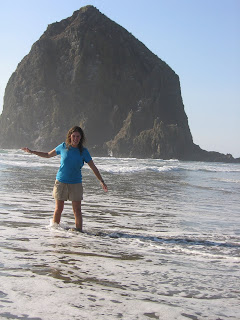
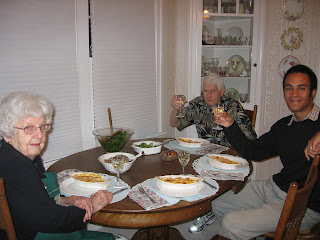
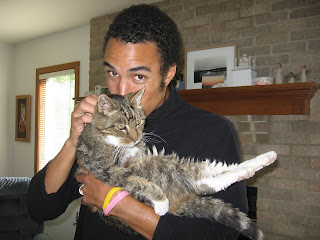
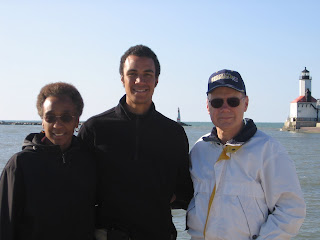
Since we last wrote, we have traveled to the States and back, finished our Project Citizen class, spent time with friends on the island of Amapala, survived our mid-term medical examinations, celebrated Daniel’s golden birthday (25 on the 25th), and disguised ourselves for Halloween. Our trip to the States was a delightful whirlwind of all the things we had missed during our first 15 months away: friends, family, the Indiana Dunes, microbrews, Cannon Beach, football, salmon, clean running water 24-7, grandparents, Little John, a democratic government, Powell’s Books, and home. We had a wonderful time and only wish it could have lasted a little longer. Here are some pictures from our trip.


Emily at Cannon Beach


Mimi, Grampur, and Daniel enjoying an exquisite meal and excellent conversation


Daniel and Little John (21 years old)


Cheryl, Daniel, and Ken in Michigan City


When we arrived back in Honduras, completing our Project Citizen class was our number one priority. Along with our wonderful counterpart, la Profesora Maria Teresa, we held numerous additional classes to make sure that the students were ready for their October 15th presentation. The night of October 14th, the Honduran fútbol team played against El Salvador to qualify for the World Cup. After a harrowing victory on behalf of Honduras, the whole country watched with bated breath for the outcome of the U.S. vs. Costa Rica game. If the U.S. won or tied, Honduras would qualify. With a spectacular goal with only seconds left in the game, the U.S. tied with Costa Rica and the country of Honduras erupted with celebration. As we were cheering their victory qualification, the de facto president announced a national holiday for the following day. Our joy turned to disappointment as we realized that the 9:00am presentation had probably just been cancelled. The following morning, we rose with little hope that anyone would be at the school when we arrived for the presentation. To our surprise and delight, even though classes had been cancelled, all the students, as well as many of the distinguished guests, had come for the presentation. After coming Saturdays, holidays, and many more classes than originally planned, it was only fitting that the students would still honor their commitment to the project, despite the national holiday.


Our Project Citizen Class


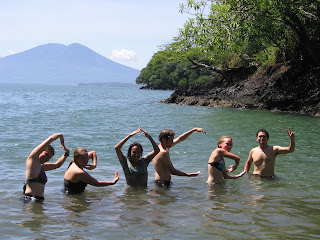
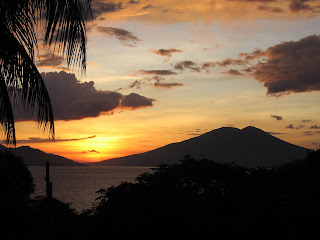
Before our Mid-term Meds, a group of volunteers decided to take advantage of already being in Tegucigalpa and travel another 3 hours south to the island of Amapala. This little island on the Pacific coast has become our favorite vacation spot in Honduras, mostly because it has not been developed for tourism. The volcanic islands of El Salvador and Nicaragua also make a spectacular backdrop for sunset photos. We spent time with friends swimming, hiking, singing, and laughing.


PEACE!
P (Emily) E (Brenna) A (Ana) C (Nathan) E (Amanda) ! (Miguel)


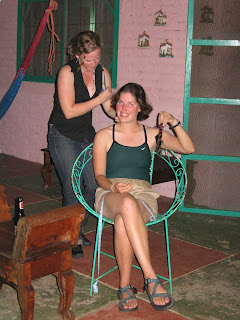
Jessica Gausman cutting Emily’s hair for Locks of Love


Sunset


After Amapala, our mid-term meds went surprisingly well. We had fun spending more time with friends and were about as healthy as could be expected after nearly 16 months in Honduras.

We hope you enjoyed our quick synopsis of the past month and a half. As always, we hope this finds you well, in good health and happiness. Finally, we will leave you with a picture of us in our Halloween costumes.


Daniel as a bus ayudante (the guy who takes your money) and Emily as an elote (ear of corn)

Wednesday, September 30, 2009

Seasons of Peace Corps

In celebration of completing one year as Peace Corps volunteers, we decided to write a tribute using the award-winning song, Seasons of Love, from the hit musical RENT. Seasons of Love illustrates the ways to measure a year, so we came up with the ways to measure a year in the life of a Peace Corps volunteer. Here goes:

Seasons of Peace Corps

Five hundred twenty five thousand six hundred minutes,
Five hundred twenty five thousand moments so dear.
Five hundred twenty five thousand six hundred minutes,
How do you measure a Peace Corps year?

In earthquakes, in kittens, in dogbites, in cups of coffee
In projects, in coups, in friendships, in strife
Five hundred twenty five thousand six hundred minutes,
How do you measure a year in the life?

(chorus)
How about love?
How about love?
How about love?
Measure in love.
Seasons of love.
Seasons of love.

Five hundred twenty five thousand six hundred minutes
Five hundred twenty five thousand bus trips to plan
Five hundred twenty five thousand six hundred minutes
How do you measure the stress of another travel ban?

In books that she read
Or in hours they talked
In the classes he led
Or the miles that she walked

Its time now to sing out
though the story never ends
lets celebrate, remember a year
in the life of friends

(chorus)

And here were a few other ways to measure a year as a volunteer in Honduras that didn’t quite make the list.

How do you measure, measure a year?

…in clothing we’ve ruined
…in stool samples
…in cups of sugary coffee
…in sleepless nights
…in the veggies we’ve planted
…in the sugar cane that we’ve chewed
…in the lessons we’ve learned
…in laughter
…in friends that we’ve made
…in emails we’ve sent
…in Spanish vocab
…in new grammatical structures
…in stitches received
…in gum boots
…in lempiras spent
…in tropical depressions
…in letters received
…in cheap macrobrews
…in ant invasions
…in places we’ve visited
…in bananas we’ve eaten
…in the times we’ve played the bean game
…in the many uses of “echar”
…in machetes
…in jalones received
…in Peace Corps points

Tuesday, August 18, 2009

Seguir Adelante - A lesson in empathy

Time for your random bit of Spanish: "seguir adelante" generally means "to go on", "to continue forward" etc. and is used in the spirit of gathering oneself to continue with a difficult task. As we sit here in the office of the NGO with whom we sometimes work trying to update our laptop’s antivirus program with a 6.6 kB/sec connection, seguir adelante takes on an entirely new meaning. Trying to download a relatively small file is scheduled to take, oh, roughly the rest of our service with the Peace Corps. And think, we were hoping to get home before dark to prepare a nice meal (when you live near the equator, darkness always sets in at 6:00, which seems abysmally early in August)!

Aside from computer problems, the breadth and duration of which we won’t bore you with here, there have continued to be a number of challenges and problems throughout the country owing to the coup that happened about a month and a half ago. Seguir adelante. To varying degrees, most people are trying to continue with their normal lives. For our part, we feel like it’s not really possible for the country to return to normal right now in any real sense because, well, the president who is officially recognized by almost every political entity around the world that has shared an opinion on the subject has effectively been barred reentry to the country unless he’s willing to be arrested and put on trial upon breaching the border. Indeed, it´s quite a conundrum. Although we have our opinions on what’s going on in the country right now, what has happened, and what’s likely to happen, we recognize this is not the forum for such ideas. For the time being we’ll just say life seems to have a sense of suspended motion right now. However, one still has to go grocery shopping, wash the clothes, cut the grass, bathe (a greater chore than you may realize), and life’s not without it’s small pleasures, like reading “Donde está Spot” to our five year old neighbor for the umpteenth time or chasing our cat, Luz, who has grown by leaps and bounds and insists on trying to flee from our yard and stalk everything in sight. Seguir adelante.

Admittedly, volunteers amongst our Peace Corps group are handling this period of uncertainty in different ways. Some volunteers have internet access in their homes while others read by candlelight for lack of electricity in their communities. For many who don’t have good access to any form of news media (typically those without electricity), it’s probably fair to say that life is relatively normal. When one lives in the countryside, life’s not quite as subject to the ebbs and flows that accompany life "connected." We’re neither connected in the modern tech sense, nor are we in the countryside. As far as we can tell, most people in our neighborhood are trying to live their normal lives while also paying attention when one of those familiar radio jingles sounds in their homes, signaling the start of another news bulletin. We’re ready to get back to work, but we’re also guarded about the success we expect due to the undercurrent of political preoccupation that has stalled and altered our work in these last 6 weeks. Seguir adelante.

¿As for empathy? We’ve been in Honduras for well over a year and while we claim no expertise on any aspect of the culture, we have experienced enough life here, in normal and abnormal days alike, to have some sense for how the average Honduran views and approaches their life. Conservative Christian faith and prayer are foundational and indispensable for nearly all. We’ve entered innumerable hypothetical conversations on various topics with Honduran friends and neighbors, all of us throwing out suppositions and theories, to ultimately say “Solo Dios sabe/only God knows.” We say it to. When you live someplace with as many unpredictable and unsettling occurrences as Honduras – between late May and late June Honduras has experienced the largest earthquake in recorded Central American history and suffered the first definitive coup to hit the region in decades, not to mention the devastating tropical storm that ushered us in to our service 10 months ago – well, at the very least one begins to realize they are not the undisputed author of their own destiny. Al revés, to flip the idea on its head, when volunteers go home to the States, even in these troubling economic times, they return to a more stable country, one where relative safety and relative political and financial stability are not necessarily unreasonable expectations. Some may even fondly think of home as a Candy Land of sorts, chock full of good pizza, ice cream, modern movie theaters, a plethora of good restaurants, and all of those other perks many miss during their service.

In spite of the comforts awaiting volunteers at home, we again ask ¿can we be empathetic? In the midst of our stresses and frustrations, and yes, joys as well, as volunteers here in Honduras do we learn to empathize with the Honduran people, those with whom we live and work? Well, to an extent. But there’s a catch, and here it is: while we get to go home, of course, Hondurans are already home. As new volunteer groups come and go, Honduras will continue in a mood it’s quite familiar with, patient resilience. It’s not joy but has the hint of a smile (or is it a grin?) and instructs that one should be happy when possible and patient when not. For volunteers who finish their service tomorrow and those who’ve yet to arrive, that patient resilience is something to be understood, and perhaps even put into practice for a time, but rarely does it become a mandatory way of life. Patient resilience pulled things back together last fall in the midst of and after the devastating tropical depression. Patient resilience will be the centerpiece as the country reassesses and reassembles itself when the current political crisis comes to an end. Patient resilience, by the way, will have nothing to do with the politics and innumerable platitudes we hear leading up to the presidential elections, scheduled to take place in November (will they be boycotted in protest?) It listens, and waits, always observes, and knows that things will be “all right” in their own time. Seguir adelante.

Saturday, July 4, 2009

We´re Just Fine

To anyone who´s following the situation in Honduras right now and may be concerned for Emily and I, we want to say that we´re doing just fine. As all of our work activities are indefinitely on hold we find ourselves eating more, gardening more, reading more, chatting more, and like anyone who´s following the situation, waiting for more news. Our personal recommnedation for reliable news surrounding this event would thus far be the BBC at bbc.co.uk All the best, and once we know anything more definitive about what the outcome of this situation is we may present our own objective synposis here.

Friday, June 5, 2009

Temblores, y gatos, y milpas, oh my!

Temblores, y gatos, y milpas, oh my!

It’s been an interesting period since we last posted around two months ago. Principally, we’ve been busy trying to start new projects and continuing with old projects. Regarding old projects first, Emily is still working at the comedor infantil helping prepare meals for young children in addition to her bi-weekly responsibilities as an English tutor. I am currently in a lull with the projects I’ve begun with my primary counterpart, which has allowed me to search for secondary projects of interest to me. Principally, along with Emily and neighborhood leaders, I am helping direct a family garden initiative in the neighborhood. Together we continue to volunteer an hour a week at the local kindergarten (reading stories, creating activities, etc.) in addition to the time we spend coaching a baseball team alongside one of our fellow Peace Corps volunteers in town. Concerning new projects, within the next two weeks we’ll begin working with a local high school teacher to implement a once-a-week class with her students focused on citizen responsibility and action. The class will be structured around an existing program called Project Citizen and we look forward to starting as, of course, there’s always a need for the development of competent and passionate public servants and citizens. If this list leads you to believe we’re quite busy, well, that wouldn’t be quite accurate. Like most volunteers we still have a great bit of downtime in which we read, occasionally watch a DVD, garden, or entertain ourselves with one of any number of silly harebrained schemes we create to have fun (remember the pila boat).

Well, I suppose we’ve left you in the dark long enough about the meaning of that jarbled title we’ve chosen for this blog. Temblor = earthquake, gato = cat, and milpa = cornfield. Within the past two weeks we’ve received an 8-week-old kitten, experienced a 7.1 earthquake, and planted a 15 square foot cornfield in our back yard. In its own strange way, each experience has been both intimidating and joyful. Now, for the explanation.

Temblores. To go in chronological order, on May 28th at approximately 2:30 a.m., I woke to a sensation of violent shaking, which initially I thought emanated from our roof due to the commotion our metal roof was making. Although highly uncommon, it’s not unprecedented for a thief to attempt to enter a home through the roof, but I quickly remembered that’s only possible with tile roofs, whose tiles can be removed to create room for a thief to slip through. Then it hit me. ¡Earthquake! “Em, wake up, we’re having an earthquake” I said hurriedly, not sure yet whether to be afraid. We jumped out of bed to wait out the last ten seconds of what we estimate to have been a forty five second earthquake. Then, as quickly as it had all began, the earthquake silently slipped away into the night as if it were a carnival attraction being powered down, our dollar apiece now exhausted. What next; cotton candy, anyone? As is common in the wake of an earthquake, our power went out. For the next half hour we waited anxiously in the dark for an aftershock, for the power to come back on, something to break the post-trauma silence settling on the city. I believe our neighbors felt the same as we heard and witnessed a few of them waiting in front of their homes, asking one another quietly, “¿Está bien?” “Are you alright?” People giggled, perhaps for the same reasons we did: surprise, relief, and a hesitant sense of joy. As luck would have it, the power came back on and we shortly returned to bed where we’d pass the rest of the night sleeping fitfully, with clothing and our headlamps at the ready beside our bed.

All things told we enjoyed the experience more than anything, which, of course, owes purely to circumstance. Our home could have crumbled, our power could have been severed for substantially longer, and our local roads could have buckled amidst a host of other severe problems. Some weren’t as lucky as us. Although the damage was remarkably low for an earthquake of that magnitude, partially due to the fact that the epicenter was North of Honduras in the Caribbean rather than on land, some people’s homes were damaged, in total 6 people lost their lives, and long term damage was done to infrastructure elsewhere in the country. I think our memory of the quake will be one of mixed emotions, true dichotomies in fact – there was the sense of excitement at feeling the otherwise serene earth wake and shake off it’s dust, accompanied by the realization of having escaped a potentially life threatening situation completely unscathed.

Gatos. Well, in fact, only one gato. And further more, it’s a she and she’s a kitten, which makes her a “gatita.” About two weeks ago we received a phone call from a fellow Peace Corps volunteer who had heard that we might be willing to adopt a kitten. Subsequently, about a week ago, we adopted Luz, which means “light” in Spanish. She had been named Lucy by her former owners, and though we had thought long and hard about a name for her – ranging from Hernando (Dan was set on the name and was disinclined to change even though it was a female cat) to Cilantro and everything in between – we still had not come to a consensus on her name. When we walked into the room to meet her for the first time, I said “Hi, Luce,” as a shortened version of Lucy, but it sounded like the Spanish word “luz.” Dan and I looked at each other and realized that we had finally found a name.


Em and Luz enjoying en evening together in the hammock while reading Jane Austen´s Emma


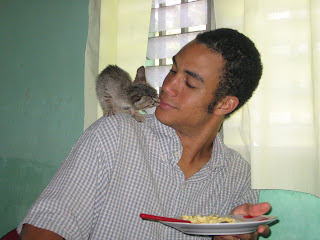
Luz is a tabby and is very energetic, as most kittens are. We are really enjoying having her around the house, though she requires a lot of attention. She often tries to perch on our shoulders at mealtimes to put herself between our food and our mouths. If we are cleaning up the house, she likes to sit upon the shoulder of the person who is washing dishes or sweeping the floor. Often she mews while up there, looking very much like a supervisor critiquing the work of her subordinate. As we sit here writing this, we are also reminded of all of the loose threads on our clothing, loose shoelaces, unplugged cords, crumbs, clothing tossed casually on the backs of chairs, fallen leaves from our indoor plants, and un-stored plastic bags, amongst other things – in short, a majority of our home that previously seemed cozy, if a bit messy, that has now proven to be anything but “kitten proof”. Even though she can be a bit demanding, it’s all worth it when she’s peacefully asleep on our laps while we’re curled up in the hammock with a good book.

How Sweet it is to Be Loved by You!

Milpa. Although we have been quite busy with different projects lately, we’ve been slowly preparing a 15x15 ft. plot of land in our backyard for planting corn. We received Sweet Corn seeds from Oregon, which we were finally able to plant last Sunday. Dan ingeniously made a fence of recycled plastic bread bags to keep the pollitos (chicks) out. As part of our project with family gardens, we wanted to experiment with different types of fencing because chicken wire is rather expensive. We planted over 200 seeds, so if all goes well we will probably be eating corn-on-the-cob, cornbread, corn soup, and anything else corn-related we could think of, as well as sharing with friends and neighbors.

How we Recycle around Here


So there you have it: Temblores, y gatos, y milpas, oh my! We have been quite busy the past couple of months and imagine that you have been as well. We hope that you are well and would love to hear what you are up to (and if you have any corn-related recipes, they would be greatly appreciated).

Leaving a Friend´s Site Early one Morning near Choluteca we Snapped This Photo


*As travel writers, albeit fledglings at best, we owe it to our audience to be as accurate as possible with our facts. In our last blog “Transcendence” we made a mistake. The Casa de Cultura (Cultural House) did not disappear in the blaze. However, the museum is indeed gone. Additionally, we mistakenly said that several items from the country´s "héroes" had dissappeared in the blaze. While it´s quite possible that the museum housed such items, what we intended to write was that the blaze consumed important documents from the lives of some of the country´s "próceres", the ideological warriors whom we know were enshrined in the museum.

Sunday, April 19, 2009

Eat Your Heart Out Hoover and Oreck; You Can´t Touch These Carpets


The Cathedral in Comayagua where a bunch of Peace Corps volunteers stood around and looked lost.


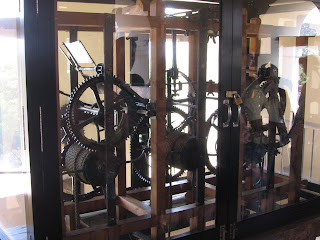
The oldest clock in the Americas located in the tower of the Cathedral


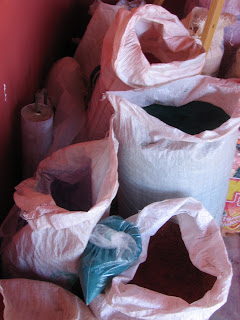
Bags of colored sawdust in preparation for the big day
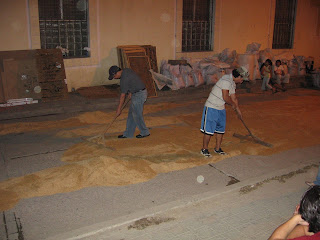
For some of the bigger alfombras, the process started around 10pm on Holy Thursday and lasted until the carpets were destroyed by the procession on Good Friday. Here they´re laying a foundation of plain sawdust before starting the layers of colored sawdust.


Here´s an example of an alfombra up close. Each group had their own technique for making their sawdust smooth, but to do the designes, everyone used homemade stencils made of cardboard. Some families have been making alfombras for decades and make a different one each year.


One of the smaller alfombras about the cultural aspects of Comayagua

This is a good example of the scale of many of the larger alfombras

Although traditionally the alfombras are made of sawdust, some include rice, dried beans, grains, leaves, pine needles, and whatever else the designers think up

Here is the full scale example of the one using non-traditional materials


A great deal of planning has to go into the process since those making them have to start in the middle and work their way out.

After the procession

Transcendence

Comayagua, Honduras. The one time head of government in Honduras and the eternal seat of Honduran culture, Comayagua is, culturally speaking, the heart of the country during Semana Santa, Holy Week. Of course, across the North coast of the country exist a plethora of beaches and resorts, both of which are popular choices for many during Semana Santa. Yet, for some good ol’ fashioned cultural, ecumenical fun, Comayagua’s the choice.

The cathedral and numerous colonial era churches found there are starkly beautiful in their scorching desert ambience, surrounded in the distance by imposing mountains that have yet to be broached by the city limits, and within the city, by shade providing tropical trees. Witnessing the hordes of churchgoers during Semana Santa is a reminder that Honduras is most definitely not a secular nation. Whether Catholic or Evangelical, the vast majority of people are Christians, many of whom consider it a life long ritual to entirely set aside their ordinary lives in remembrance of Jesus during Semana Santa.

Along with thousands of Hondurans, foreign tourists, and expatriates we observed and took part in many of the rich traditions Comayagua is so well known for. From attending an evening church service in the cathedral to touring Comayagua’s colonial museum and house of culture, known for artifacts of not only local but also national and international interest, to viewing the world famous alfombras, or carpets, that are artfully and painstakingly created on the city’s streets, we saw a great deal and, to be humble and honest, left a great deal unseen as well. We felt as if we were discovering something new, and yet transcendent, as we visited the museum and house of culture and viewed the alfombras being built (a process that lasts some 12 hours). The irony of our trip was that what we experienced as new and transcendent (so much timeless culture expressed with such potency, beauty, and precision) was soon to disappear, forever.

Every year the procession of Christ carrying the cross travels through the heart of the colonial capital, tramples and quickly destroys the several dozen ornately decorated carpets, which are displayed on temporarily blocked off streets throughout downtown. We knew to expect the destruction of the carpets, which are made of multicolored sawdust and tediously arranged on the processional route because, after all, they are delicate and made to be unmade. What no one expected was the disappearance of the museum and house of culture, which went up in flames only a few days ago, less than a week after we stood there, marveling at wooden masks, colonial era priestly garb, priceless jewelry, and precious documents from the lives of Honduras’ heroes. As an interesting aside, the word “héroe” (hero) is only used with reference to those who have physically fought on behalf of the nation. There is another word, commonly used and clearly distinct from héroe, used for the nations ideological and intellectual warriors, “prócer”. No one yet knows what caused the blaze but it’s plausible that the 100 + temperatures that have hovered over Comayagua recently caused a gas tank explosion. There’s also talk of an electrical fire.

We may never know what started the blaze, and I’m not sure it much matters. What we do know is that all that is transcendent, that quality we so appreciate about the many intangible beauties wrapped up in culture, for instance, is never truly encapsulated in what we can touch, but rather must be remembered by and enshrined in our senses. As we watched Christ bearing his cross through the streets – albeit a highly fantastical plastic Christ – little did we know how well that great life, ended over 2,000 years ago now, would so potently remind us of the present.

Artifacts are but stubborn things (albeit, artfully and painstakingly created beautiful things of historic value) that have yet to hand over the reigns to eternity. In a sense we mourn with the city of Comayagua – it lost a great deal in that fire. We also recognize that if a plastic figurine can duly remind us of the life of Christ, lived and terminated in a time so long ago that human civilization had better philosophized about what heaven consisted of than it had understood the basic shape of the earth, whatever was great about what was burnt in Comayagua will not disappear, but rather must take a new form. We left the city on the eve of the creation of transcendence.

Tuesday, April 7, 2009

Field Trip!

On Thursday, we had some special visitors to our house...approximately 60 kindergarteners! Dan and I have started going to the nearby kindergarten, which is about 2 ½ blocks away from our house, one day each week to teach a little something (eg. how to brush their teeth, wash their hands, etc.) We received a syllabus from the teachers there, so we can contribute to the themes they are already learning about. For the first class – which Dan couldn’t go to because of a Peace Corps training – I read Buenas Noches, Luna, the Spanish version of the beloved classic, Good Night, Moon, because the kids were learning about how to greet people.

The kiddos huddled around the garden


Our second class, we led a field trip to our house to show them our vegetable garden and compost pile. After leading the children up the street and into our yard, which felt eerily like being the Pied Piper, we had the children gather around our small chicken wire fence, which encloses the garden, to learn about growing produce. We identified the rows of fruits and veggies – cucumber, lettuce, tomato, spinach, artichoke (which they had never heard of, and which is not growing particularly well), carrot, and watermelon. We explained the purpose of the fence around the garden by pointing to the chicks that were tromping around our yard. We also discussed the growth of each plant and why we believed some were growing better than others (for example, the lettuce has thrived in this climate, but the watermelon does not receive enough sun).

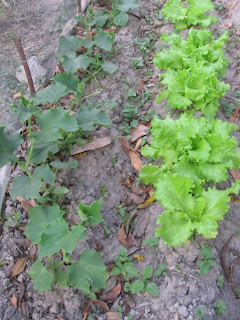
Cucumber on the left and lettuce on the right (salad, anyone?)
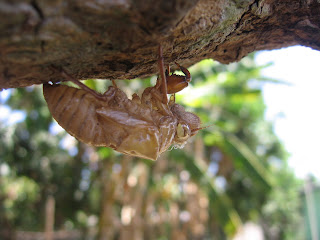
Then we walked over to the compost pile, and when Dan asked the children what they saw, they responded “¡Basura!” or “Garbage!” The eggshells, fruit peelings, cow manure, and leaves did indeed look like a pile of garbage, but we tried to explain why those particular items were there. After talking for a while about “plant food,” Dan finished up the lesson by pointing out the skeletal shells of what had formerly been locusts, which appeared on some of our trees a week or so ago. The children were delighted by the delicate, translucent, insect forms, and we were soon surrounded by the outstretched hands of children – the girls were as excited as the boys – hoping to receive one of the precious gifts.


Think cliff hanger, only on a smaller scale and confined to the insect world

Of course, kindergarteners are still too young to be starting their own vegetable garden, but we wanted to show them that even within the city limits, healthy fruits and veggies can be grown, and maybe they will be inspired to have a garden of their own some day. As far as the compost pile goes, in a country where most people burn their trash – most places don’t have garbage pickup, and those that do have their garbage burned by the local government (Siguatepeque’s trash is burned outside of the city, overlooking a watershed) – any time we can provide people an alternative use for some of their trash, we seize the opportunity.

Friday, March 20, 2009

¡El Día de San Patricio! (St. Paddy’s Day!)

In honor of the Emerald Isle, we decided to invite some friends over for a traditional St. Paddy’s Day dinner. Once the invitations were out and we had a rough idea of how many would be coming, the next step was to try to track down the necessary ingredients. Dan, in his infinite wisdom, managed to chip a tooth – not to worry, it didn’t hurt – by chewing on sugar cane, warranting a trip to the dentist in Tegucigalpa. I decided to accompany him, and while Dan had his tooth worked on, I embarked on an epic search for corned beef and Irish whiskey. Much to my dismay, while there were infinite options of Scotch Whiskey and at least one Tennessee Whiskey, there was no Irish whiskey to be found. I did find Carolan’s Irish Cream – a product of Ireland, no less – which would serve for Irish coffee. My search for corned beef was equally disappointing as the only corned beef to be found was in a SPAM-shaped can and a product of Brazil (and also far more expensive than I was willing to spend on such a product)! We decided not to take our chances with the canned variety and to go with plan B: an Irish beef stew.

After being thwarted by the grocery stores of Teguc, we returned to Siguatepeque to prepare for the dinner. Since our guests were traveling from far and wide, some of them came in on Friday for the festivities on Saturday. We dined at the best restaurant Siguat has to offer: Pizzeria Venezia, which is owned by an Italian family and is a true sight for sore eyes for volunteers from smaller sites. Saturday morning, the Siguatepeque baseball team had a game, so Dan fulfilled his coaching duties, Erik, a visiting friend from the South, umpped, and the rest of our guests were able to watch the glory and splendor that is little-league baseball, Honduran style (Siguatepeque won both games, by the way).

The menu for the evening was as follows:

Appetizers:
Green M&Ms (peanut and regular)
Lime and Chili Almonds
Key Lime Bars
Guacamole and Chips (going with the green theme)

Dinner:
Colcannon (traditional mashed potatoes with cabbage)
Irish Soda Bread
Irish Beef Stew

Dessert:
Irish Bread Pudding
Irish Coffee


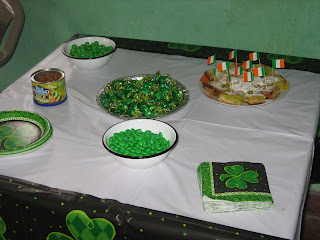
Table decorations and appetizers, thanks to Mary Casey


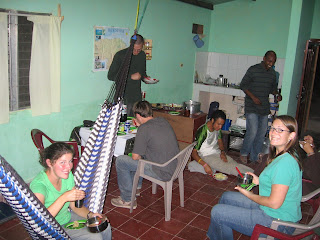
Everyone enjoying the food wherever there was room (Right to left: Emily, Mark, Nathan, Daniel, Erik, Lauren, Not pictured: Jessica, Ana, David)


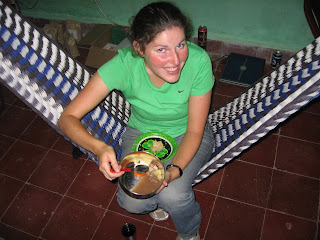
Emily eating in the hammock


We had a fun evening of good food, great company, and plenty of toasting the Irish. Our guests even tolerated a couple of my Irish jokes. It was a fun cultural exchange of a different sort (normally we are learning about Honduran culture and foods) in which I got to explain that the big X on the soda bread comes from the tradition of blessing the bread and everyone discovered how wonderfully potatoes and cabbage go together in Colcannon. David, one of our site mates, even came in a kilt, so what more could we ask for?! We hope you had a wonderful St. Paddy’s Day, wherever you were and that you drank a Guinness for us (we were stuck with one of the Honduran macro-brews). Thanks for all the emails and letters; please keep them coming. And as said in Ireland, Erin Go Braugh!


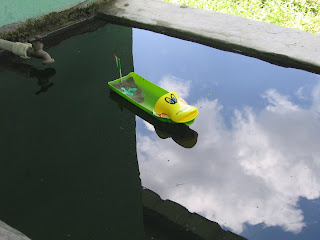
P.S. We have long been thinking that what our pila needed most was a boat, but it was not until the arrival of the little Irish flags that my mom sent that Dan started making the worthy craft. With some duck lips from the Kellers at the stern, the Irish flag at the helm, and a halved bottle of shampoo as the hull, a more fearsome ship there never was! So here is a picture of the first launch of the most dreaded ship on the high seas, La Pata Irlandesa or The Irish Duck.