Saturday, July 4, 2009
We´re Just Fine

Friday, June 5, 2009
Temblores, y gatos, y milpas, oh my!
It’s been an interesting period since we last posted around two months ago. Principally, we’ve been busy trying to start new projects and continuing with old projects. Regarding old projects first, Emily is still working at the comedor infantil helping prepare meals for young children in addition to her bi-weekly responsibilities as an English tutor. I am currently in a lull with the projects I’ve begun with my primary counterpart, which has allowed me to search for secondary projects of interest to me. Principally, along with Emily and neighborhood leaders, I am helping direct a family garden initiative in the neighborhood. Together we continue to volunteer an hour a week at the local kindergarten (reading stories, creating activities, etc.) in addition to the time we spend coaching a baseball team alongside one of our fellow Peace Corps volunteers in town. Concerning new projects, within the next two weeks we’ll begin working with a local high school teacher to implement a once-a-week class with her students focused on citizen responsibility and action. The class will be structured around an existing program called Project Citizen and we look forward to starting as, of course, there’s always a need for the development of competent and passionate public servants and citizens. If this list leads you to believe we’re quite busy, well, that wouldn’t be quite accurate. Like most volunteers we still have a great bit of downtime in which we read, occasionally watch a DVD, garden, or entertain ourselves with one of any number of silly harebrained schemes we create to have fun (remember the pila boat).
Well, I suppose we’ve left you in the dark long enough about the meaning of that jarbled title we’ve chosen for this blog. Temblor = earthquake, gato = cat, and milpa = cornfield. Within the past two weeks we’ve received an 8-week-old kitten, experienced a 7.1 earthquake, and planted a 15 square foot cornfield in our back yard. In its own strange way, each experience has been both intimidating and joyful. Now, for the explanation.
Temblores. To go in chronological order, on May 28th at approximately 2:30 a.m., I woke to a sensation of violent shaking, which initially I thought emanated from our roof due to the commotion our metal roof was making. Although highly uncommon, it’s not unprecedented for a thief to attempt to enter a home through the roof, but I quickly remembered that’s only possible with tile roofs, whose tiles can be removed to create room for a thief to slip through. Then it hit me. ¡Earthquake! “Em, wake up, we’re having an earthquake” I said hurriedly, not sure yet whether to be afraid. We jumped out of bed to wait out the last ten seconds of what we estimate to have been a forty five second earthquake. Then, as quickly as it had all began, the earthquake silently slipped away into the night as if it were a carnival attraction being powered down, our dollar apiece now exhausted. What next; cotton candy, anyone? As is common in the wake of an earthquake, our power went out. For the next half hour we waited anxiously in the dark for an aftershock, for the power to come back on, something to break the post-trauma silence settling on the city. I believe our neighbors felt the same as we heard and witnessed a few of them waiting in front of their homes, asking one another quietly, “¿Está bien?” “Are you alright?” People giggled, perhaps for the same reasons we did: surprise, relief, and a hesitant sense of joy. As luck would have it, the power came back on and we shortly returned to bed where we’d pass the rest of the night sleeping fitfully, with clothing and our headlamps at the ready beside our bed.
All things told we enjoyed the experience more than anything, which, of course, owes purely to circumstance. Our home could have crumbled, our power could have been severed for substantially longer, and our local roads could have buckled amidst a host of other severe problems. Some weren’t as lucky as us. Although the damage was remarkably low for an earthquake of that magnitude, partially due to the fact that the epicenter was North of Honduras in the Caribbean rather than on land, some people’s homes were damaged, in total 6 people lost their lives, and long term damage was done to infrastructure elsewhere in the country. I think our memory of the quake will be one of mixed emotions, true dichotomies in fact – there was the sense of excitement at feeling the otherwise serene earth wake and shake off it’s dust, accompanied by the realization of having escaped a potentially life threatening situation completely unscathed.
Gatos. Well, in fact, only one gato. And further more, it’s a she and she’s a kitten, which makes her a “gatita.” About two weeks ago we received a phone call from a fellow Peace Corps volunteer who had heard that we might be willing to adopt a kitten. Subsequently, about a week ago, we adopted Luz, which means “light” in Spanish. She had been named Lucy by her former owners, and though we had thought long and hard about a name for her – ranging from Hernando (Dan was set on the name and was disinclined to change even though it was a female cat) to Cilantro and everything in between – we still had not come to a consensus on her name. When we walked into the room to meet her for the first time, I said “Hi, Luce,” as a shortened version of Lucy, but it sounded like the Spanish word “luz.” Dan and I looked at each other and realized that we had finally found a name.
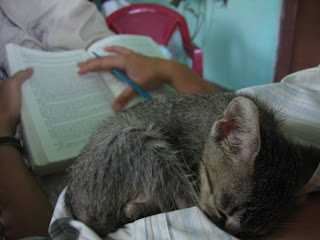
Em and Luz enjoying en evening together in the hammock while reading Jane Austen´s Emma
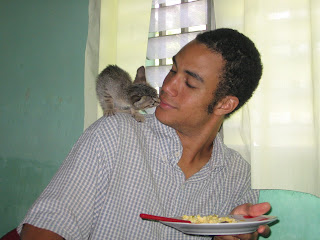
Luz is a tabby and is very energetic, as most kittens are. We are really enjoying having her around the house, though she requires a lot of attention. She often tries to perch on our shoulders at mealtimes to put herself between our food and our mouths. If we are cleaning up the house, she likes to sit upon the shoulder of the person who is washing dishes or sweeping the floor. Often she mews while up there, looking very much like a supervisor critiquing the work of her subordinate. As we sit here writing this, we are also reminded of all of the loose threads on our clothing, loose shoelaces, unplugged cords, crumbs, clothing tossed casually on the backs of chairs, fallen leaves from our indoor plants, and un-stored plastic bags, amongst other things – in short, a majority of our home that previously seemed cozy, if a bit messy, that has now proven to be anything but “kitten proof”. Even though she can be a bit demanding, it’s all worth it when she’s peacefully asleep on our laps while we’re curled up in the hammock with a good book.
Milpa. Although we have been quite busy with different projects lately, we’ve been slowly preparing a 15x15 ft. plot of land in our backyard for planting corn. We received Sweet Corn seeds from Oregon, which we were finally able to plant last Sunday. Dan ingeniously made a fence of recycled plastic bread bags to keep the pollitos (chicks) out. As part of our project with family gardens, we wanted to experiment with different types of fencing because chicken wire is rather expensive. We planted over 200 seeds, so if all goes well we will probably be eating corn-on-the-cob, cornbread, corn soup, and anything else corn-related we could think of, as well as sharing with friends and neighbors.

How we Recycle around Here
So there you have it: Temblores, y gatos, y milpas, oh my! We have been quite busy the past couple of months and imagine that you have been as well. We hope that you are well and would love to hear what you are up to (and if you have any corn-related recipes, they would be greatly appreciated).
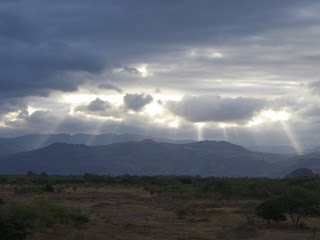
Leaving a Friend´s Site Early one Morning near Choluteca we Snapped This Photo
*As travel writers, albeit fledglings at best, we owe it to our audience to be as accurate as possible with our facts. In our last blog “Transcendence” we made a mistake. The Casa de Cultura (Cultural House) did not disappear in the blaze. However, the museum is indeed gone. Additionally, we mistakenly said that several items from the country´s "héroes" had dissappeared in the blaze. While it´s quite possible that the museum housed such items, what we intended to write was that the blaze consumed important documents from the lives of some of the country´s "próceres", the ideological warriors whom we know were enshrined in the museum.
Sunday, April 19, 2009
Eat Your Heart Out Hoover and Oreck; You Can´t Touch These Carpets

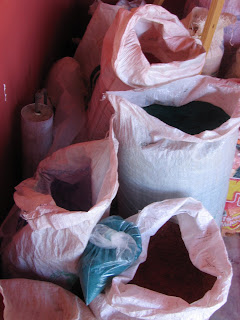
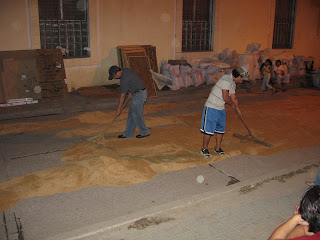 For some of the bigger alfombras, the process started around 10pm on Holy Thursday and lasted until the carpets were destroyed by the procession on Good Friday. Here they´re laying a foundation of plain sawdust before starting the layers of colored sawdust.
Here´s an example of an alfombra up close. Each group had their own technique for making their sawdust smooth, but to do the designes, everyone used homemade stencils made of cardboard. Some families have been making alfombras for decades and make a different one each year.

One of the smaller alfombras about the cultural aspects of Comayagua
 This is a good example of the scale of many of the larger alfombras
 Although traditionally the alfombras are made of sawdust, some include rice, dried beans, grains, leaves, pine needles, and whatever else the designers think up
 Here is the full scale example of the one using non-traditional materials
 A great deal of planning has to go into the process since those making them have to start in the middle and work their way out.
 After the procession
Transcendence
The cathedral and numerous colonial era churches found there are starkly beautiful in their scorching desert ambience, surrounded in the distance by imposing mountains that have yet to be broached by the city limits, and within the city, by shade providing tropical trees. Witnessing the hordes of churchgoers during Semana Santa is a reminder that Honduras is most definitely not a secular nation. Whether Catholic or Evangelical, the vast majority of people are Christians, many of whom consider it a life long ritual to entirely set aside their ordinary lives in remembrance of Jesus during Semana Santa.
Along with thousands of Hondurans, foreign tourists, and expatriates we observed and took part in many of the rich traditions Comayagua is so well known for. From attending an evening church service in the cathedral to touring Comayagua’s colonial museum and house of culture, known for artifacts of not only local but also national and international interest, to viewing the world famous alfombras, or carpets, that are artfully and painstakingly created on the city’s streets, we saw a great deal and, to be humble and honest, left a great deal unseen as well. We felt as if we were discovering something new, and yet transcendent, as we visited the museum and house of culture and viewed the alfombras being built (a process that lasts some 12 hours). The irony of our trip was that what we experienced as new and transcendent (so much timeless culture expressed with such potency, beauty, and precision) was soon to disappear, forever.
Every year the procession of Christ carrying the cross travels through the heart of the colonial capital, tramples and quickly destroys the several dozen ornately decorated carpets, which are displayed on temporarily blocked off streets throughout downtown. We knew to expect the destruction of the carpets, which are made of multicolored sawdust and tediously arranged on the processional route because, after all, they are delicate and made to be unmade. What no one expected was the disappearance of the museum and house of culture, which went up in flames only a few days ago, less than a week after we stood there, marveling at wooden masks, colonial era priestly garb, priceless jewelry, and precious documents from the lives of Honduras’ heroes. As an interesting aside, the word “héroe” (hero) is only used with reference to those who have physically fought on behalf of the nation. There is another word, commonly used and clearly distinct from héroe, used for the nations ideological and intellectual warriors, “prócer”. No one yet knows what caused the blaze but it’s plausible that the 100 + temperatures that have hovered over Comayagua recently caused a gas tank explosion. There’s also talk of an electrical fire.
We may never know what started the blaze, and I’m not sure it much matters. What we do know is that all that is transcendent, that quality we so appreciate about the many intangible beauties wrapped up in culture, for instance, is never truly encapsulated in what we can touch, but rather must be remembered by and enshrined in our senses. As we watched Christ bearing his cross through the streets – albeit a highly fantastical plastic Christ – little did we know how well that great life, ended over 2,000 years ago now, would so potently remind us of the present.
Artifacts are but stubborn things (albeit, artfully and painstakingly created beautiful things of historic value) that have yet to hand over the reigns to eternity. In a sense we mourn with the city of Comayagua – it lost a great deal in that fire. We also recognize that if a plastic figurine can duly remind us of the life of Christ, lived and terminated in a time so long ago that human civilization had better philosophized about what heaven consisted of than it had understood the basic shape of the earth, whatever was great about what was burnt in Comayagua will not disappear, but rather must take a new form. We left the city on the eve of the creation of transcendence.
Tuesday, April 7, 2009
Field Trip!

The kiddos huddled around the garden
Our second class, we led a field trip to our house to show them our vegetable garden and compost pile. After leading the children up the street and into our yard, which felt eerily like being the Pied Piper, we had the children gather around our small chicken wire fence, which encloses the garden, to learn about growing produce. We identified the rows of fruits and veggies – cucumber, lettuce, tomato, spinach, artichoke (which they had never heard of, and which is not growing particularly well), carrot, and watermelon. We explained the purpose of the fence around the garden by pointing to the chicks that were tromping around our yard. We also discussed the growth of each plant and why we believed some were growing better than others (for example, the lettuce has thrived in this climate, but the watermelon does not receive enough sun).
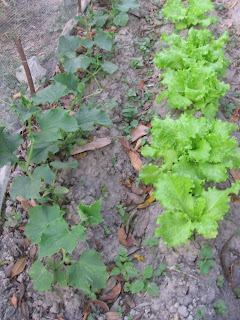 Cucumber on the left and lettuce on the right (salad, anyone?)
Then we walked over to the compost pile, and when Dan asked the children what they saw, they responded “¡Basura!” or “Garbage!” The eggshells, fruit peelings, cow manure, and leaves did indeed look like a pile of garbage, but we tried to explain why those particular items were there. After talking for a while about “plant food,” Dan finished up the lesson by pointing out the skeletal shells of what had formerly been locusts, which appeared on some of our trees a week or so ago. The children were delighted by the delicate, translucent, insect forms, and we were soon surrounded by the outstretched hands of children – the girls were as excited as the boys – hoping to receive one of the precious gifts.
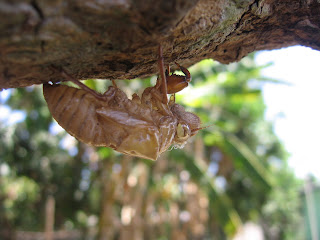 Think cliff hanger, only on a smaller scale and confined to the insect world
Of course, kindergarteners are still too young to be starting their own vegetable garden, but we wanted to show them that even within the city limits, healthy fruits and veggies can be grown, and maybe they will be inspired to have a garden of their own some day. As far as the compost pile goes, in a country where most people burn their trash – most places don’t have garbage pickup, and those that do have their garbage burned by the local government (Siguatepeque’s trash is burned outside of the city, overlooking a watershed) – any time we can provide people an alternative use for some of their trash, we seize the opportunity.
Friday, March 20, 2009
¡El Día de San Patricio! (St. Paddy’s Day!)
After being thwarted by the grocery stores of Teguc, we returned to Siguatepeque to prepare for the dinner. Since our guests were traveling from far and wide, some of them came in on Friday for the festivities on Saturday. We dined at the best restaurant Siguat has to offer: Pizzeria Venezia, which is owned by an Italian family and is a true sight for sore eyes for volunteers from smaller sites. Saturday morning, the Siguatepeque baseball team had a game, so Dan fulfilled his coaching duties, Erik, a visiting friend from the South, umpped, and the rest of our guests were able to watch the glory and splendor that is little-league baseball, Honduran style (Siguatepeque won both games, by the way).
The menu for the evening was as follows:
Appetizers:
Green M&Ms (peanut and regular)
Lime and Chili Almonds
Key Lime Bars
Guacamole and Chips (going with the green theme)
Dinner:
Colcannon (traditional mashed potatoes with cabbage)
Irish Soda Bread
Irish Beef Stew
Dessert:
Irish Bread Pudding
Irish Coffee
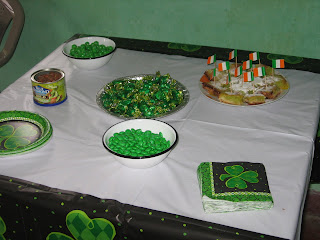
Table decorations and appetizers, thanks to Mary Casey
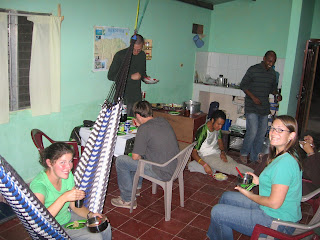
Everyone enjoying the food wherever there was room (Right to left: Emily, Mark, Nathan, Daniel, Erik, Lauren, Not pictured: Jessica, Ana, David)
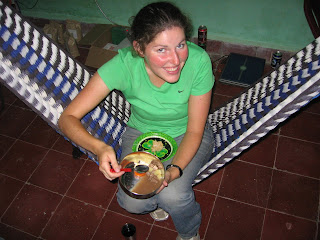
Emily eating in the hammock
We had a fun evening of good food, great company, and plenty of toasting the Irish. Our guests even tolerated a couple of my Irish jokes. It was a fun cultural exchange of a different sort (normally we are learning about Honduran culture and foods) in which I got to explain that the big X on the soda bread comes from the tradition of blessing the bread and everyone discovered how wonderfully potatoes and cabbage go together in Colcannon. David, one of our site mates, even came in a kilt, so what more could we ask for?! We hope you had a wonderful St. Paddy’s Day, wherever you were and that you drank a Guinness for us (we were stuck with one of the Honduran macro-brews). Thanks for all the emails and letters; please keep them coming. And as said in Ireland, Erin Go Braugh!
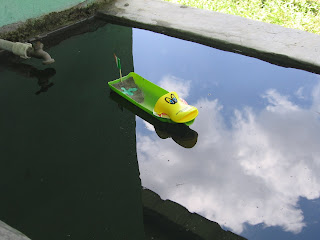
P.S. We have long been thinking that what our pila needed most was a boat, but it was not until the arrival of the little Irish flags that my mom sent that Dan started making the worthy craft. With some duck lips from the Kellers at the stern, the Irish flag at the helm, and a halved bottle of shampoo as the hull, a more fearsome ship there never was! So here is a picture of the first launch of the most dreaded ship on the high seas, La Pata Irlandesa or The Irish Duck.

Tuesday, March 17, 2009
The Thrill of White Water
If you were expecting a post about rafting, or for that matter, anything related to water sports, apologies. Shortly after our last post we headed out for a week to construct latrines with a group of volunteers from the United States, most of whom hailed from a church group in the Seattle area. They were definitely a fun group to be with for the week we spent together, and we hope that we were both fun and functional for them, as work partners and in our primary role as translators. For any of you who are map-readers, find the town of Minas de Oro (Gold Mines) in the middle of Honduras, and then head northwest. Contingent upon how detailed a map you’re using, you may or may not see the small community of Agua Blanca. Agua Blanca means White Water in English, but in this case refers to the one time color of the community´s water as opposed to rafts, adrenaline sports, etc. For those of you who aren’t map-readers, find the country of Honduras, located in the middle of Central America, and focus on an arbitrary point in the middle of the country – that should do the trick.
Agua Blanca, a small, picturesque community in the central highlands of the country was our home for a week, during which our group collaborated with community members to construct 36 latrines for the homes that most needed them. For a majority of us this was to be our first foray into latrine construction, and suffice it to say that the week began slowly as our group and the local volunteers and beneficiaries of the project took time to successfully begin their collaboration. In large part due to the language barrier it was difficult for the two groups to quickly and spontaneously communicate with each other, despite Emily and my best efforts as translators. Regardless, the two groups made headway together bit by bit, using a combination of translation, newly acquired Spanish and English vocab, and good old fashioned gestures – after all, it’s not too tough to mimic the motion of hammering – and by the end of our second day of work, even the most fit and strongest of the group were showing a few signs of fatigue. As I expect most who read this can understand, it’s tough to maneuver shovels full of sand and cement, swing hammers, saw rebar and wood, and all beneath a sun than can definitively, albeit temporarily, change one’s complexion in a matter of only a couple hours.
 When mixing cement, make a volcano, fill it
with water, cave in the sides, repeat
For those of you who are unfamiliar with the process of constructing a latrine, we’ll give you a brief description. The families that were to receive latrines were required to have their holes dug before we arrived. The holes needed to be at least 8 feet deep and were roughly 3 feet in diameter, all of which were dug by hand, some of which in particularly rocky terrain. The first step for us was to tapar, or cover, the hole with cement. In order to do so, we placed boards over the hole, placed formwork around the boards, and filled the formwork with rocks and rebar. Two small holes were left in the formwork. The first hole was intended to allow a tube to be connected between the outhouse and the collection hole. Another smaller hole was left in one of the centermost boards to leave space for the tube that we would vertically insert into the hole to serve as an air vent for the collection hole, helping to vent the methane and thereby prevent any accidental bomb construction. Then the cement was mixed by hand – an intricate process needing both finesse and brute strength – and poured into the formwork, covering the rebar and stones.
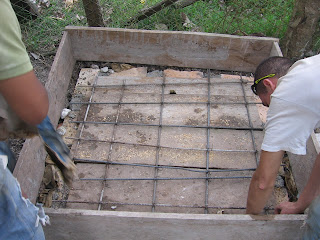
Formwork, equipped with rebar, and soon, stones
The following day, the outhouses were put up. While some volunteers were tapando the holes, others were putting together the metal siding of the outhouses. Once finished, the outhouses were transported to individual homes, where we were in charge of getting them set up. The most difficult part of this process was attempting to get the outhouses level, a challenge that was complicated by the fact that many of the outhouses themselves were not level (which can be attributed to some minor damages they suffered during the transportation process, as opposed to poor construction). Once an outhouse was finally level, concrete was poured into wooden formwork, identical to that described in the previous paragraph, that surrounded the outhouse, thereby creating a foundation for it. Finally, a third and much smaller form was placed on the newly poured foundation of the outhouse, filled with rocks and rebar, equipped with a "throne" and subsequently filled with cement. Finally, a large PVC tube was connected between the toilet bowl and the hole that was previously left in the concrete slab which sits atop the collection hole. These latrines are gravity fed, and therefore, after use, one can simply pour water into the bowl itself and the toilet will “flush” downhill to the hole.
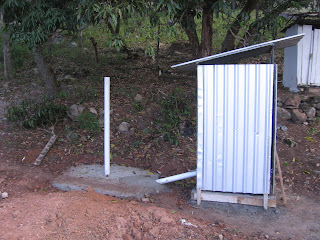
The final product, in all of its splendor
In addition to constructing latrines, an interesting and challenging process that arguably was as much fun as it was work, the time we spent in Agua Blanca was culturally quite memorable. For Emily and I, as volunteers who regularly split our time between urban and rural environments, many of our experiences in Agua Blanca were new, but not surprisingly new as was the case for many volunteers from our group. For instance, seeing some of the depraved living conditions that are so common throughout Honduras no longer elicits a strong response from us, even though we’re here as committed and empathetic volunteers; “Asi es, es la vida,” as one learns to say.
Although we’re accustomed to seeing certain forms of depravity and hardship, even we were taken off guard by a few circumstances, such as the following. A large cow was somehow separated from its herd and, with caballero and a pack of street dogs in toe, it wove its way through the streets, visibly confused and frightened. Needless to say, the group of 15 or so dogs wasn’t some sort of excessively large super herding crew; rather, it was a pack of rather vicious street dogs that was quickly learning to follow it’s ancestral instincts (The Call of the Wild, anyone). Although the dogs didn’t kill the cow, nor, in truth, did they really come close, they did manage to severely lacerate the cow’s ears, and had the caballero not been there to scare the dogs away, the cow may have succumb to an Animal Planet worthy hunt.
The lengthy scene that followed, on the order of a couple hours, consisted in the caballeros, three in total by now, employing various means of abusing and frightening the cow so as to wake it from its nearly catatonic fear induced state owing to the dog attack. As strange as it may sound, we deliberately chose not to intervene and suggest a more humanitarian approach to moving the cow – simply said, it was not our place. You will be happy to know, however, that the caballeros eventually found their own less violent solution to the problem by bringing down the entire herd to where they’d tied up the cow and then leading the herd back to the corral, giving the frightened cow that precious sensation of strength in numbers.
In the same breath as highlighting one of the all too common incidents of animal cruelty we’ve seen in Honduras, if we claim to be discussing Honduran culture with regard to our time in Agua Blanca, we must also acknowledge how well we were fed, housed and otherwise received by the community. The group was always greeted kindly by community members, from the youngest schoolchildren to the elders. On a few seperate occassions we were also treated to beautiful impromptu musical performances by singing children and guitar and accordion playing adults. The backdrop to all of the other wonderful forms of hospitality was our food. Every day, three times a day, we sat perched in our standard fare plastic chairs, in dirty clothing, overlooking a breathtaking view and eating like the queens and kings of latrines that we were. We were happy in one another’s company, sharing a new experience and living in the parallel worlds of giving and receiving, worlds that to Emily and I seem distinct yet irrevocably connected in our everyday lives as volunteers.
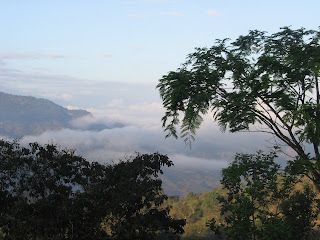
La Buena Vista - The Beautiful View