Friday, March 12, 2010

Luz, Lucero, and a decidedly positive busyness

Luz, Lucero, and a decidedly positive busyness

Many of you will have already heard us speak about Luz, our kitten, who is quickly becoming a cat – if not in size then at least in attitude. We’ve already had her for nearly nine months and she’ll soon be completing her first year as of some time in April. Admittedly, this blog is not intended for telling stories about our cat (although, of course, we are fond of her) but rather to our overall experience as Peace Corps volunteers in Honduras. However, in the nature of sharing with you a bit about our lives here, let us share with you an anecdote about none other than Luz.

In most parts of the United States it’s commonplace to have a pet spayed as a young animal. Because we hope to bring Luz back to the States with us, and also as a general measure toward her long-term health, we decided to have her spayed here in Honduras while she’s still young. We’re fortunate enough to have a competent veterinary here in our town that does the surgery for 3,500 Lempira, which translates to about $175 USD. That’s not a tremendously high price to pay, but considering that our daily wages apiece are 170 Lempira (following that same 20 to 1 approximate conversion, that’s about $8 USD) it does take a bit of deliberate saving to afford such an operation. Largely because of that relatively high price, it is not at all common to spay or neuter an animal here – it’s a custom mostly reserved to the wealthier strata of society who see their animals principally as pets (i.e. nice animals to be nurtured) as opposed to mice chasers in the case of cats, human chasers as is the case for dogs, etc. It’s a done deal, though. For about two-thirds of one of our monthly salaries, Luz was spayed and is now well on her way to being a happy, healthy, kitten-less kitty.


A nice cat´s eye view

In the context of spending money on our cat, and in the broader context of comparing our lifestyles as volunteers with those of our Honduran peers, a few important details surface. One of our old neighbors (we’ve since moved to a slightly nicer, albeit still humble home) earned about 5,000 Lempira ($250 USD) monthly as a mason, which was slightly supplemented by his wife who worked as a cleaning woman. That 5,000 Lempira wasn’t too poor a salary in comparison with many others in the area, and on that salary not only he and his wife, but also their two children were dependent for all necessities.

As mentioned explicitly in a previous blog, and interspersed subtly throughout many others, as Peace Corps volunteers we live a simple life and strive to live as close to local norms as possible. Just to share a few examples, we travel by foot nearly any time we’re traveling within a 5 mile radius of our home, do a large portion of our shopping at the standard open air market in town, dress in humble clothing, and typically eat at home. Most of this we do with great pleasure (for those of you who know us, you already know how much we appreciate exercise, a humble presentation of ourselves, and eating simply), but for those things that we do with great relish along with those which we do grudgingly, our primary focus is that we maintain a sustainable standard of living according to local norms.

It is, however, only fair that we acknowledge the great differences in vulnerability and privilege between the humble lives we lead and those of our Honduran peers. When we get sick, are injured, etc. we’re entitled to the best medical care available (including, if necessary, being sent to specialists in Panama or Washington D.C.). To look at a broader trajectory of our lives, when we’ve completed our 27-month commitment with the Peace Corps, most of us have promising professional opportunities to explore, a more secure society to return to (for instance, remember that coups about 9 months ago?), and in general a more privileged lifestyle according to most indicators social scientists might employ to make such a determination. All of this is to say, try as we might to be humble and to walk in the shoes of the average Honduran, we are still foreign volunteers and do ultimately live a more privileged lifestyle, as does our cat as compared to her cat peers.

On to Lucero. In the past several months we’ve befriended a local horse, who we fondly named Claudia. At least once a week, we feed her carrots purchased from our local market, pet her a bit, and brush the flies away from her eyes. Claudia is a brown and white painted horse and is certainly one of the highlights of our walk into town. By speaking with a young boy who tends her along with about a dozen cattle, we’ve recently learned that she’s about 4 years old. When asking the boy about her age, we also had the surprise of learning that she has a name, and that it’s different than what we’d named her. Have we ever mentioned that here, as foreign volunteers, we sometimes find ourselves being thrust back into our childhood, if not toddler years? What we mean to say is that there are experiences one has as a volunteer abroad that force her to try to interpret her surroundings and come to conclusions without all of the relevant information that would otherwise be available in her home environment. So, yes, we assumed that Claudia didn’t have a name (she’s a horse, after all, and let’s remember that animals are typically first and foremost animals here) and provided her with a name that we thought was fitting, if not a bit presumptuous for a horse.


Enjoying a mid-afternoon snack


Well, as it turns out, her real name, Lucero, is quite fitting for her. She’s a beautiful horse, is quite affectionate, and her name means brilliant star. We now call her Lucero Claudia. That makes her name seem a bit more authentic, anyhow. In the Spanish tradition, many people have two first names and it’s customary that everyone have two last names, the first of which represents the father’s side of the family and the second of which represents the mother’s. If in the spirit of providing a simple illustration you’ll take a leap with us for a moment and consider that Lucero were a person, and take another even greater leap and consider that she were our child (we provide this example with the all important caveat that we are NOT at all yet interested in having children, nor a horse for that matter), her name would be Lucero Claudia Keller Casey.

Lucero has always been a bit healthier looking than most of her peers. She has a large pasture in which to graze and is obviously well groomed by her owner. She always seemed a bit too healthy, though, and as a result we’d often said (largely in jest) that perhaps she was pregnant. However, not having known her for more than 6 months, and not knowing how long the gestation period is for horses (we’re now pretty sure it's about 9 months) we really had no idea whether her large girth was normal or a sign of pregnancy. The birth of her filly five days ago, however, was the ultimate proof (unfortunately, we were not there for the birth). We’re not yet sure what to name her, but we’re certainly accepting suggestions. It's probably true that she already has a name, but that won’t deter us – she’ll just have one more. As a final side note, in case you like horses and want a few more details on the birth (we certainly hope you can at least tolerate horses, otherwise this must be an insufferable story for you), the filly has been running, if not sprinting, since day one, probably weighs near 80-100 lbs. and, per the local custom, has a red ribbon tied round her neck (yes, she’s everything that we think of when using the word “adorable”).


Also enjoying a mid-afternoon snack

As for the busyness, well, we’ve been pretty busy of late. Since the start of the school year about a month ago, we’ve been teaching English with a night school program, have made solid plans with a local school to open a library and have a young student or two trained to function as part-time librarian (thanks once more to those of you who so generously donated books for this project!), have begun to make plans for co-teaching a civics class with a local teacher, and have contributed to a preliminary plan for a series of community facilities to be built in a local neighborhood.

We imagine that our next blog will be filled with more details on these various projects as they come to fruition. In the meantime, thank you, as always, for taking an interest in our goings on. Don’t hesitate to email us (eckeller1@gmail.com, danielkeller1@gmail.com) or post comments to the blog if you have any questions, curiosities, name suggestions for the filly, etc. Otherwise, take care and here’s to wishing you all the best from Honduras!

Tuesday, January 5, 2010

The Rainy Day Good News

The Rainy Day Good News

As I'm fond of hearing John Lennon say around this time of year, another year is over and a new one just begun. Aside from being a fan of the man’s music, I like the song because it reminds me to begin the new year with a sense of optimism. This time around it is particularly nice to hear those words – new year. While I am going to talk politics for a brief moment, don’t worry, this isn’t destined to be another exposé on the political goings on of Honduras. Suffice it to say that last year was a pretty miserable year for almost all of Honduras (a perfect storm of political and economic upheaval that went a long way toward paralyzing the country) and the prospect of starting over again, albeit largely in a symbolic sense, is encouraging.

Better yet, there are also practical gains to be made in the near future. First of all, a new president will take office by the end of January, helping reestablish many economic and diplomatic ties that were severed between Honduras and other nations in the wake of the June 28th coup. The year 2010 will also bring Honduras its first birth in the World Cup since 1982. For a country this soccer crazed, qualifying for the World Cup is always a big deal, but this year’s Cup promises to be an event of national importance with few parallels in the nation’s history given the timing; soccer is the common man’s politics, leaving no room for empty public posturing, back room reciprocity, reneging on promises or any of the other man-inflicted plagues Honduras knows with such painful intimacy. Nope, in soccer you just go out and play, and if you’re corrupt, foolish or lazy and happen to be on Honduras’ national team, tens of thousands of your peers will let you know of their disapproval, immediately. So there you have it – 2010 will be a better year for Honduras, and hopefully one in which the common man’s politics will rule the roost. It'd be about time.

Today, however, is not a good day for soccer as it has already rained quite a bit. Not the deluge, life silencing by relentlessly pounding the tin roof sort of storm we often get here, but rather a drawn out, yet gentle storm. Yesterday was much the same. In fact, we decided it prudent to pull out our botas de goma (gum boots, anyone?) to head to the local outdoor market where we purchased fruits and vegetables for the week ahead. Prior to yesterday the last time we’d donned our gum boots, or for that matter had any reason to, was about a year ago at the close of the last rainy season. This year’s rainy season has not been particularly rainy. In fact, being an el niño year, the rain fall has been so sparse that during the past few months national and local leaders alike have begun to worry about an impending and potentially devastating drought.

The last prediction I read in one of Honduras’ national papers was that as of March a drought could be gripping large swaths of the country and that as of, well, now (January), some of the more marginalized neighborhoods in the capital city of Tegucigalpa could have such limited access to water so as to make them uninhabitable, which is a grim omen considering how little water they often get by with. It's always healthy to take the news here with a grain of salt (sensationalistic headlines that are refuted days, if not hours later, are not uncommon) but I do think there’s great cause for concern. One journalist recently compared the drought’s potential impact with that of Hurricane Mitch, claiming this drought could be the greatest natural hazard to affect the country since ´98 when Mitch ravaged all of Honduras and set some areas back on the order of decades. Other than being judicious with our personal water consumption (the norm in most households), there’s not much more to do on this front other than to do what humans have done for eons when they need rain – crane our necks to the sky and hope that clouds appear and that those clouds carry rain. There’s been some talk about the UN chipping in with aid (and let’s hope it's fruitful), but in less they’re proposing the start of a revolutionary cloud seeding program, I'll mostly just keep my neck craned and hope that the coming days bring more rainy day good news.

Thursday, November 5, 2009

La Gata Alunada and other tales from Honduras

I wish we could in good faith say it was strange to have received advice from our 9-year-old neighbor about how to deal with our 8-month-old cat that’s going into heat, but, alas, that’s not the world we live in. Here, acquiring knowledge about the procreation habits of animals accompanies, if not precedes learning the ABCs, not by design but rather by circumstance. We know of no one in our immediate neighborhood that has their pets spade or neutered. Why? It's expensive, for one. The nearest vet who can do the job is a 2 and a half hour bus trip away, plus taxi fare, all stacked atop costs of the operation itself. Additionally, most domestic animals here have two shifts to fulfill: during the waking hours they’re expected to be friendly to their owners, playmates to children and otherwise stoic fixtures of the streetscape, grudgingly moving for and subsequently staring down all passersby (which I would argue is perhaps the most important of their roles), while at night, cats pursue and eat all varieties of critter (ours eats cockroaches, others eat mice, you get the point) and dogs are employed as guardians. I feel these animals' supreme functionality contributes to their being viewed not so much as pets to be cared for but as animals to, well, be animals.

Enough sidestepping the issue, though; we, as the caretakers, or parents if you will, of Luz, an 8-month-old tabby, are facing the tough news that she is capable of having kittens, heralded to us not only by the confidently delivered lectures of a young girl but also by the nearly incessant screeching of a fluffy white male cat. As could be inferred by what I stated earlier, this situation wouldn’t present much of a problem to most anyone who lives near us. If Luz were under the stead of our neighbors she would likely become pregnant, give birth, and become another in the slew of unruly animals in our neighborhood who periodically disturb the peace with their wild, lascivious behavior. On one side of our home we are bordered by a humble yellow church, whose lot is occupied a few days a month by several dogs from the neighborhood that are, you guessed it, engaging in illicit acts. Incidentally, this very morning I was privy to such a scene when I stepped outside to collect water from our pila, barely awake and still cleaning from my eyes the remnants of my sleep. We have a different vision for our cat, though. Right, wrong, or somewhere in the gray, she will be getting spade as soon as possible. That, however, will be another day’s tale.

Aside from looking after our cat, there are a few other ways in which we occupy our time these days. To proceed in chronological order, on September 21st the exiled president made a surprise return to Honduras, from which time he has successfully sought refuge within the Brazilian embassy in the Honduran capital, Tegucigalpa. Since his return, he and the interim/de facto government have taken part in an intense series of negotiations aimed at returning some semblance of normalcy and direction to the country’s political future. To date, there have been advances in the negotiations, but nothing that presents a definitive solution to the problem. Owing to the continued political uncertainty, coupled with the fact that Honduras is supposed to be hosting it's national elections at the end of November, the interim/de facto government declared that the school year (already terribly truncated by the political instability and concerns about the spread of the H1N1 flu virus) would end in mid October rather than late November to ensure that the voting stations – most, if not all of which, are schools – would be secure to host the vote. We were lucky to have previously planned to end our two existing projects by mid October. Several of our friends, however, were in the midst of school related projects at the time of the declaration and have needed to postpone or cancel their projects. It's fair to say that no one in the country has been unscathed by the coup, and volunteers are no exception. So, on to what we’re hoping to do in the near future. Since the school year has been prematurely terminated, and many of the kids who live near us are in want of productive ways to use their time, we’re hoping to start a reading club along with a library project so as to create an interest in leisure reading amongst children who have had very limited exposure to books, particularly outside of school.

All of that said, for the next month our attention will be increasingly focused on how the country prepares itself for its upcoming national elections. I think we, like most everyone, are hoping that somehow in the course of the next month Honduras will successfully prepare for and host its elections, ultimately resulting in a clearer path by which it can begin to heal itself as the new president assumes power in January.

Synopsis

To those devoted enthusiasts of our humble prose, please accept our sincerest regrets for the tardiness of our entry. To assuage your umbrage, we offer, in recompense, a duo of inscriptions. Um, I mean, sorry it took us so long, dudes. Here are two blogs to make up for it.

Since we last wrote, we have traveled to the States and back, finished our Project Citizen class, spent time with friends on the island of Amapala, survived our mid-term medical examinations, celebrated Daniel’s golden birthday (25 on the 25th), and disguised ourselves for Halloween. Our trip to the States was a delightful whirlwind of all the things we had missed during our first 15 months away: friends, family, the Indiana Dunes, microbrews, Cannon Beach, football, salmon, clean running water 24-7, grandparents, Little John, a democratic government, Powell’s Books, and home. We had a wonderful time and only wish it could have lasted a little longer. Here are some pictures from our trip.


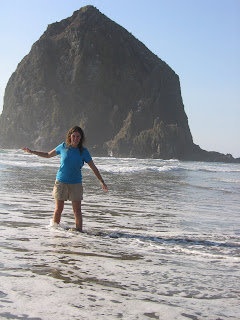
Emily at Cannon Beach


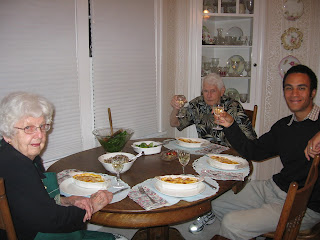
Mimi, Grampur, and Daniel enjoying an exquisite meal and excellent conversation


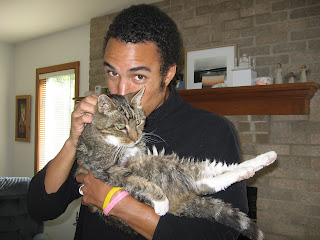
Daniel and Little John (21 years old)


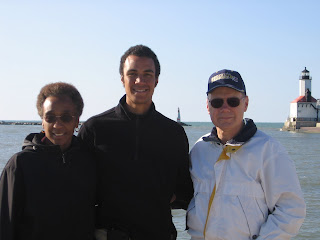
Cheryl, Daniel, and Ken in Michigan City


When we arrived back in Honduras, completing our Project Citizen class was our number one priority. Along with our wonderful counterpart, la Profesora Maria Teresa, we held numerous additional classes to make sure that the students were ready for their October 15th presentation. The night of October 14th, the Honduran fútbol team played against El Salvador to qualify for the World Cup. After a harrowing victory on behalf of Honduras, the whole country watched with bated breath for the outcome of the U.S. vs. Costa Rica game. If the U.S. won or tied, Honduras would qualify. With a spectacular goal with only seconds left in the game, the U.S. tied with Costa Rica and the country of Honduras erupted with celebration. As we were cheering their victory qualification, the de facto president announced a national holiday for the following day. Our joy turned to disappointment as we realized that the 9:00am presentation had probably just been cancelled. The following morning, we rose with little hope that anyone would be at the school when we arrived for the presentation. To our surprise and delight, even though classes had been cancelled, all the students, as well as many of the distinguished guests, had come for the presentation. After coming Saturdays, holidays, and many more classes than originally planned, it was only fitting that the students would still honor their commitment to the project, despite the national holiday.


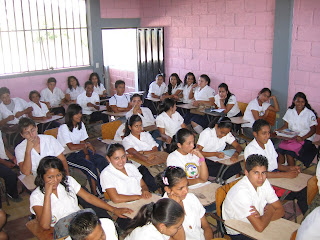
Our Project Citizen Class


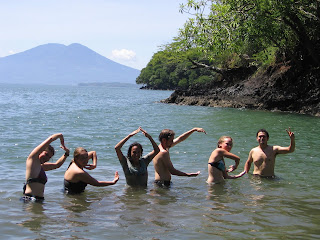
Before our Mid-term Meds, a group of volunteers decided to take advantage of already being in Tegucigalpa and travel another 3 hours south to the island of Amapala. This little island on the Pacific coast has become our favorite vacation spot in Honduras, mostly because it has not been developed for tourism. The volcanic islands of El Salvador and Nicaragua also make a spectacular backdrop for sunset photos. We spent time with friends swimming, hiking, singing, and laughing.


PEACE!
P (Emily) E (Brenna) A (Ana) C (Nathan) E (Amanda) ! (Miguel)


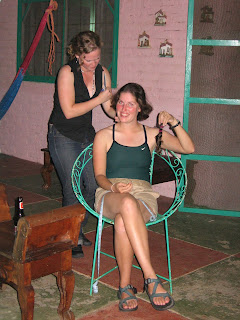
Jessica Gausman cutting Emily’s hair for Locks of Love


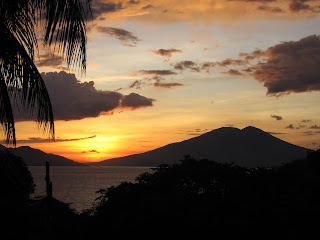
Sunset


After Amapala, our mid-term meds went surprisingly well. We had fun spending more time with friends and were about as healthy as could be expected after nearly 16 months in Honduras.

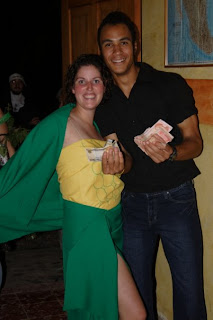
We hope you enjoyed our quick synopsis of the past month and a half. As always, we hope this finds you well, in good health and happiness. Finally, we will leave you with a picture of us in our Halloween costumes.


Daniel as a bus ayudante (the guy who takes your money) and Emily as an elote (ear of corn)

Wednesday, September 30, 2009

Seasons of Peace Corps

In celebration of completing one year as Peace Corps volunteers, we decided to write a tribute using the award-winning song, Seasons of Love, from the hit musical RENT. Seasons of Love illustrates the ways to measure a year, so we came up with the ways to measure a year in the life of a Peace Corps volunteer. Here goes:

Seasons of Peace Corps

Five hundred twenty five thousand six hundred minutes,
Five hundred twenty five thousand moments so dear.
Five hundred twenty five thousand six hundred minutes,
How do you measure a Peace Corps year?

In earthquakes, in kittens, in dogbites, in cups of coffee
In projects, in coups, in friendships, in strife
Five hundred twenty five thousand six hundred minutes,
How do you measure a year in the life?

(chorus)
How about love?
How about love?
How about love?
Measure in love.
Seasons of love.
Seasons of love.

Five hundred twenty five thousand six hundred minutes
Five hundred twenty five thousand bus trips to plan
Five hundred twenty five thousand six hundred minutes
How do you measure the stress of another travel ban?

In books that she read
Or in hours they talked
In the classes he led
Or the miles that she walked

Its time now to sing out
though the story never ends
lets celebrate, remember a year
in the life of friends

(chorus)

And here were a few other ways to measure a year as a volunteer in Honduras that didn’t quite make the list.

How do you measure, measure a year?

…in clothing we’ve ruined
…in stool samples
…in cups of sugary coffee
…in sleepless nights
…in the veggies we’ve planted
…in the sugar cane that we’ve chewed
…in the lessons we’ve learned
…in laughter
…in friends that we’ve made
…in emails we’ve sent
…in Spanish vocab
…in new grammatical structures
…in stitches received
…in gum boots
…in lempiras spent
…in tropical depressions
…in letters received
…in cheap macrobrews
…in ant invasions
…in places we’ve visited
…in bananas we’ve eaten
…in the times we’ve played the bean game
…in the many uses of “echar”
…in machetes
…in jalones received
…in Peace Corps points

Tuesday, August 18, 2009

Seguir Adelante - A lesson in empathy

Time for your random bit of Spanish: "seguir adelante" generally means "to go on", "to continue forward" etc. and is used in the spirit of gathering oneself to continue with a difficult task. As we sit here in the office of the NGO with whom we sometimes work trying to update our laptop’s antivirus program with a 6.6 kB/sec connection, seguir adelante takes on an entirely new meaning. Trying to download a relatively small file is scheduled to take, oh, roughly the rest of our service with the Peace Corps. And think, we were hoping to get home before dark to prepare a nice meal (when you live near the equator, darkness always sets in at 6:00, which seems abysmally early in August)!

Aside from computer problems, the breadth and duration of which we won’t bore you with here, there have continued to be a number of challenges and problems throughout the country owing to the coup that happened about a month and a half ago. Seguir adelante. To varying degrees, most people are trying to continue with their normal lives. For our part, we feel like it’s not really possible for the country to return to normal right now in any real sense because, well, the president who is officially recognized by almost every political entity around the world that has shared an opinion on the subject has effectively been barred reentry to the country unless he’s willing to be arrested and put on trial upon breaching the border. Indeed, it´s quite a conundrum. Although we have our opinions on what’s going on in the country right now, what has happened, and what’s likely to happen, we recognize this is not the forum for such ideas. For the time being we’ll just say life seems to have a sense of suspended motion right now. However, one still has to go grocery shopping, wash the clothes, cut the grass, bathe (a greater chore than you may realize), and life’s not without it’s small pleasures, like reading “Donde está Spot” to our five year old neighbor for the umpteenth time or chasing our cat, Luz, who has grown by leaps and bounds and insists on trying to flee from our yard and stalk everything in sight. Seguir adelante.

Admittedly, volunteers amongst our Peace Corps group are handling this period of uncertainty in different ways. Some volunteers have internet access in their homes while others read by candlelight for lack of electricity in their communities. For many who don’t have good access to any form of news media (typically those without electricity), it’s probably fair to say that life is relatively normal. When one lives in the countryside, life’s not quite as subject to the ebbs and flows that accompany life "connected." We’re neither connected in the modern tech sense, nor are we in the countryside. As far as we can tell, most people in our neighborhood are trying to live their normal lives while also paying attention when one of those familiar radio jingles sounds in their homes, signaling the start of another news bulletin. We’re ready to get back to work, but we’re also guarded about the success we expect due to the undercurrent of political preoccupation that has stalled and altered our work in these last 6 weeks. Seguir adelante.

¿As for empathy? We’ve been in Honduras for well over a year and while we claim no expertise on any aspect of the culture, we have experienced enough life here, in normal and abnormal days alike, to have some sense for how the average Honduran views and approaches their life. Conservative Christian faith and prayer are foundational and indispensable for nearly all. We’ve entered innumerable hypothetical conversations on various topics with Honduran friends and neighbors, all of us throwing out suppositions and theories, to ultimately say “Solo Dios sabe/only God knows.” We say it to. When you live someplace with as many unpredictable and unsettling occurrences as Honduras – between late May and late June Honduras has experienced the largest earthquake in recorded Central American history and suffered the first definitive coup to hit the region in decades, not to mention the devastating tropical storm that ushered us in to our service 10 months ago – well, at the very least one begins to realize they are not the undisputed author of their own destiny. Al revés, to flip the idea on its head, when volunteers go home to the States, even in these troubling economic times, they return to a more stable country, one where relative safety and relative political and financial stability are not necessarily unreasonable expectations. Some may even fondly think of home as a Candy Land of sorts, chock full of good pizza, ice cream, modern movie theaters, a plethora of good restaurants, and all of those other perks many miss during their service.

In spite of the comforts awaiting volunteers at home, we again ask ¿can we be empathetic? In the midst of our stresses and frustrations, and yes, joys as well, as volunteers here in Honduras do we learn to empathize with the Honduran people, those with whom we live and work? Well, to an extent. But there’s a catch, and here it is: while we get to go home, of course, Hondurans are already home. As new volunteer groups come and go, Honduras will continue in a mood it’s quite familiar with, patient resilience. It’s not joy but has the hint of a smile (or is it a grin?) and instructs that one should be happy when possible and patient when not. For volunteers who finish their service tomorrow and those who’ve yet to arrive, that patient resilience is something to be understood, and perhaps even put into practice for a time, but rarely does it become a mandatory way of life. Patient resilience pulled things back together last fall in the midst of and after the devastating tropical depression. Patient resilience will be the centerpiece as the country reassesses and reassembles itself when the current political crisis comes to an end. Patient resilience, by the way, will have nothing to do with the politics and innumerable platitudes we hear leading up to the presidential elections, scheduled to take place in November (will they be boycotted in protest?) It listens, and waits, always observes, and knows that things will be “all right” in their own time. Seguir adelante.

Saturday, July 4, 2009

We´re Just Fine

To anyone who´s following the situation in Honduras right now and may be concerned for Emily and I, we want to say that we´re doing just fine. As all of our work activities are indefinitely on hold we find ourselves eating more, gardening more, reading more, chatting more, and like anyone who´s following the situation, waiting for more news. Our personal recommnedation for reliable news surrounding this event would thus far be the BBC at bbc.co.uk All the best, and once we know anything more definitive about what the outcome of this situation is we may present our own objective synposis here.