Tuesday, January 27, 2009

¡Bamanos Pues!

¡Bamanos Pues!

By a quirk of the Spanish language we’re able to bring you the aforementioned word play. For the non-Spanish speakers in the audience, the phrase “¡Vamanos pues!” usually translates to something like “Let’s go, then!” Alright, so here’s the quirk; B and V are very often indistinguishable in spoken Spanish, and depending on where you find yourself, they are often used interchangeably in written Spanish as well. So, please join us for an enthusiastic “¡Bamanos pues!” Why? Well, of course, for our new president. Not to digress too extensively from the purpose of this blog, which is a nearly unyielding focus on all things “us”, but we must say that as the ambassadors of sorts we are as PC volunteers, it is so very refreshing to have a president who both appreciates the art of diplomacy and promises to practice it, consistently and skillfully. The promise of Obama as a skilled statesman, albeit almost entirely untested as yet, has spread to the far reaches. Anecdotally, Obama is mentioned in the political conversations we hear here as often as Honduran and other Latin American politicians. Also, due to our relative similarity of stature and skin tone, one of my co-workers has fondly taken to calling me Obama and jokingly quizzing me about policies as one would the president. All word play, anecdotes and jest aside, we are decidedly happy to have this man in the office of president.

Alright, back to Honduras. We’re doing quite well, between settling into our new home and looking forward to new work opportunities. Regarding our home, as previously written, we’re completely moved in, new paint and all. Our remaining focus is on tearing apart a defunct earthen oven that was left in our back yard (it was approximately one cubic meter), continuing to grow our compost pile, and planting our garden.

Gardening has been entertaining in unexpected ways. It would seem that our back yard was previously employed as a makeshift dump. In addition to the half dozen hours we’ve devoted to picking up bits and pieces of trash, the process of preparing our 10 ft. X 10 ft. garden plot has been an amateur archaeologist’s dream. We’ve already uncovered in the ballpark of 20 fragments from a shattered plate, shards of glass, batteries (corroded beyond the influence of Coca-Cola), warped fragments of rusted metal, spent bottles of nail polish, and old clay roof tiles, amongst other items. Keeping with the theme of amateur archaeology, these “precious finds” have certainly kept us amused, and may for a while yet if we decide to reemploy the plate fragments as our newest puzzle set; we’ll see. Although the majority of our fun has come from digging, while preparing the topsoil of our garden Emily has also been nipped by one our neighbor’s chicks (yep, small, fuzzy, yellow, and equipped with a beak), who was visiting to feast on the earthworms we uncovered. Perhaps most surprising of all, today Emily mistook a young tarantula for a clump of dirt. Fortunately it began moving before she could move it!


With regard to work, after over three months of supporting Aldea Global in many capacities Emily will begin volunteering with another organization that works to support orphaned children. Another Peace Corps volunteer worked with this organization in the past and had a very meaningful experience there. Thus far we understand that Emily will likely be supporting the children in at least a few capacities, from teaching and hosting other educational initiatives for they and their adoptive families to helping collect information about how well the organization and its affiliates are supporting the children to ensure they’re given the best care possible. Emily has long had an interest in supporting orphaned children and her work with this new organization promises to be fulfilling and challenging.

I am currently beginning work alongside a fellow PC volunteer who’s an architect as well as my counterpart and a civil engineer to design and plan for the construction of a biological research station to be built this spring. My role, owing to my background in urban planning rather than construction know how or design savvy, is helping ensure the location and design of the research station (which will be located in a national park here in Honduras) are consistent with the park’s development goals. I am also still working to get started on a project to map and delineate several of the park’s watersheds. Along with a few other volunteers in the area, and likely with Emily’s editing skills coming in handy very shortly, I am also helping to compile an informative brochure to educate local community members about the need to and advantage of preserving the park.

We would be remiss not to mention our part time job of helping coach a little league team. Whether we’re instructing on the basics of executing a bunt or teaching how to properly field a fly ball, it’s safe to say that we’re having fun, getting a decent amount of exercise, and, let’s hope, serving as positive role models.

As a parting thought, we’ll leave you with a short poem, intended both to redeem myself (Dan) after my last endeavor and more importantly, to give a taste for some of the simple things we appreciate about our experience thus far. All the best and please stay in touch!


I am a young experience in the happening and an eager memory in the making

I am the rooster’s crowing through day and night, I am the midnight dogfight whose bark foretells its bite

I am a full night sky with very small stars, whose brilliance teach that Earth is only one very small world; one very big very small world that can’t impress the universe and that can’t help but fascinate her stewards

I am the clever paradox of a pure, clean, dirty, dusty road

I am the wandering calf, colt, and chirping chick, constant reminders of and constantly reminded of the perennial necessity to venture forth and in so doing learn the meaning of exploration

I, too, am the please go away bludgeoning torrential rain and the please come again subtle morning mist

I am the constant sense of sensitivity in our tin roof, creaking under sun energy, crackling in the rain

I am a young experience in the happening and an eager memory in the making in one very big very small world, and I am t h a n k f u l for the complexities I’m learning to see in such a simple life

Monday, January 5, 2009

Feliz Año Nuevo

Since we last wrote, we have been preparing our house and have celebrated Christmas and New Years. When we moved into the house, all it had inside was a pile of duffel bags, a bed, and a bad interior paint job. Since that time, we have painted, gotten a table and chairs, hung a hammock inside, and started to make the house look like a home. The process of buying household necessities has been a long one – with many to-do lists and whole days devoted just to running errands – and has left us reminiscing fondly about one-stop-shopping at Target.


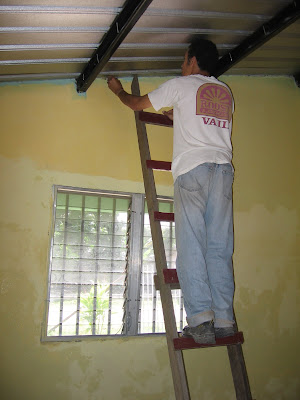
Dan painting on the lop-sided ladder


For Christmas, we headed to La Esperanza to celebrate with friends. Miguel, who traveled 7 hours from his site in the south, met us in Siguat and, after eating a lunch of baleadas (flour tortillas with refried beans and sour cream, which go for as little as 25 US cents apiece), we hopped on a bus for the hour-long trip to La Esperanza. Once there, we enjoyed relaxing at Mark and Lauren’s house on Christmas Eve. Miguel brought his guitar and my (Emily’s) grandmother sent a book of Christmas carols that she had found in a thrift shop, so we gathered around and sang together. On Christmas day, we did a bit of walking around the city, cooked dinner, and at different times someone would slip out to talk to family back home.


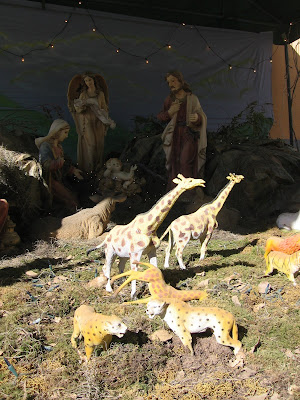
The Nativity scene in La Esperanza


(who knew there were cheetahs and giraffes in Bethlehem)


Christmas dinner consisted of a turkey, gravy, cranberry sauce, garlic mashed potatoes, green bean casserole, and sweet potato pie. Whenever cooking in Honduras, creativity is a must. My original plan was to make the sweet potato pie before we left Siguat and take it with us, already made. When I was reading the recipe, however, and the pie crust instructions stated “place dough in refrigerator for 30 minutes,” the plans changed, as we do not currently have a fridge. Fortunately, Mark and Lauren were kind enough to lend us theirs. The next step was to “place the dough between two sheets of Saran wrap and roll it out.” Since we didn’t have any Saran wrap, I put it inside a plastic grocery bag, which worked just fine. When we peeled the sweet potatoes, all of which looked the same on the outside, only one of the four was orange and the other three were tan. They all tasted the same, but the pie wasn’t nearly as pretty as usual. But, as the Irish Night Before Christmas ends, “´Tis ne´r a Christmas when everything’s right, Merry Christmas to all and to all a good night.”

After returning home for a few days, we headed up to the North Coast to celebrate the New Year with 10 other H13ers (11 of us are from Municipal Development and Lauren is a Youth Development volunteer who has Muni-D envy). We spent New Year’s Eve swimming in the Caribbean and eating fresh fish and tajadas (fried green plantains with salt that are the French fries of Honduras). When we rang in the New Year, the ball had already dropped in New York, so Dan held up a balloon and slowly lowered it as we counted down to midnight.

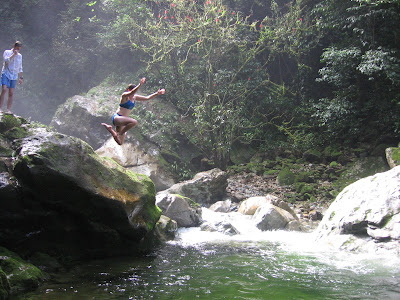
On New Year’s Day, we hiked in Parque Nacional Pico Bonito. We hiked for about an hour and a half to a waterfall, where we went swimming and ate PB&Js before heading back. The water was cold and refreshing and deep enough that we could jump off a 10 foot rock. Natán, who had formerly been a gymnast and diver, flipped off the rock, but the rest of us were satisfied with simply jumping. The vegetation was lush, verdant, and tropical, so while admiring the beauty of it all, it was hard to convince ourselves that it was the first of January. It certainly felt like a good way to start off the New Year, though.


Emilia saltando (Emily jumping)


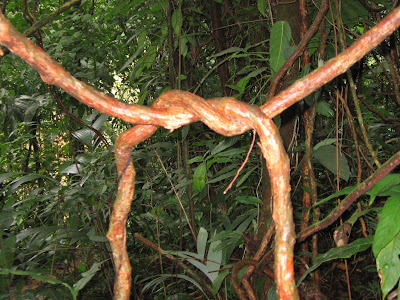
A natural knot


Our final day of vacation was spent swimming and walking on the beach. For lunch, we decided to splurge and go to a beach-side restaurant to take advantage of more fresh seafood. We shared Camarones al Ajillo (Garlic Shrimp) and Sopa de Caracol (Conch Soup). Both were excellent, but the conch soup, made with fresh coconut milk, was superb! The camarones came with arroz y frijoles (rice and beans) and tajadas. The conch soup also came with tajadas and rice that we mixed into the soup. With a cold beer, good company, and a view of the ocean, it was a perfect meal.


Dan, Emily, Natán, Ana, and our awesome food


After a bit of R & R, it´s time to get back to work! We will continue to work with Aldea Global and are also preparing to work with other NGOs and schools. We´ll keep you posted as that unfolds.

Whether you were buried in snow, worrying about getting sunburned or somewhere in between, we hope you had a Merry Christmas and a Happy New Year. Thanks for the letters, emails and packages. We always love hearing from you!


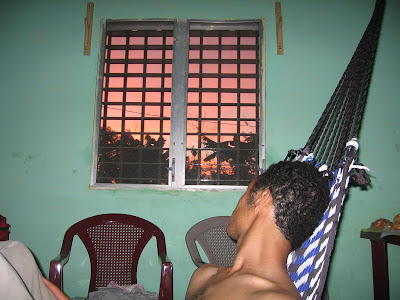
Dan watching the sunset from our livingroom

Wednesday, December 17, 2008

Running from the runs, and a bit of holiday cheer

Since we last posted, the two major events in our lives have been getting ready to move and digestive issues (warning: if hearing about digestive issues makes you queasy, please skip to the section below the tribute). After nearly five months without having major stomach problems – a near miracle for new Peace Corps volunteers – Dan had it coming out of both ends so we headed to the Hospital Evangelico (our second visit; my dog bite being the first). When his stool sample was analyzed, his diagnosis was a virus and bacteria. A week of antibiotics and rehydration salts – more about those later – and he was back to normal.

About a week after his recovery, we both had the runs again. Since this is a fairly normal occurrence in our Peace Corps experience, I wasn’t too concerned for myself, but was worried that perhaps Dan needed more antibiotics, so back to the hospital we went (trip number three). This time, Dan’s diagnosis was parasites, or as they are sometimes called in the campo, animalitos (the direct translation is “little animals”). Three or four days later, with a low fever and continuing digestive issues, I decided that perhaps I, too, had animalitos. When we went to the Hospital Evangelico for our fourth visit in a little over two months in Siguat, my diagnosis was also parasites. We learned two important things from this experience: Peace Corps volunteers have wonderful medical care, and that the old saying is true: the couple that shares parasites together stays together.

After drinking rehydration salts, called Sorassel, on and off for numerous weeks, our appreciation of them is great. Dan, the poet laureate of all problems digestive, has written a tribute in their honor, which we hope you will enjoy.

A long overdue tribute to Sorassel – Sales de Rehidratacion Oral

Diarrhea, vomit, diarrhea again, days and nights alongside old friend John,
Parasites, viruses, bacteria too have made guest appearances at the toilathon,
12 select ingredients, sensuous and simple, rehydrate our parched souls,
7.1 grams of granulated solution replace our mournful losses to toilet bowls,
Glucosa Anhidra, dear friend that it is, constitutes much of this magic elixir,
Neither Pepsi nor Coke nor exotic fruits could dare hope to trump this mixer,
We must also make mention of another olive carrying dove, sodium, as well
Which delicately delivers peace to our stomachs after antibiotics have raised hell,
Pour, mix, and drink it up until the scorching sun bakes the bottom of the cup
And as the cup’s core is seared all the more, to the last precious drop we’ll sup,
Sorassel, sweet and salty, deliverer of countless brilliant and microscopic pearls
Diligently instructs how to dissolve and create that precious gift for he who hurls,
Sorassel, dear sweet, and salty, Sorassel, to the world we owe your story to tell

Now that our systems are back to normal, all of our energy can be fixed on getting our house ready. After living with host families for over five months, and house searching for two, we finally found the perfect house. It is a little green house with a front porch that will be perfect for chatting with neighbors and a backyard that will allow us to plant sugarcane, corn, papaya, bananas, a little vegetable garden, and anything else we could hope for. There are already two mango trees there (to those who are interested in visiting: mango season is roughly March-May), which we hope will be bearing an abundance of fruit in the springtime. Fortunately, our next-door-neighbor has a tree that produces so many mangos she can’t give them away, so even if our trees are still too young to bear fruit, we will be able to work out a deal with her.


Our house from the backyard


We are currently cleaning the house in preparation for painting before we finally move in. The neighborhood we are in does not have water 24-7, so we have water in half-days (for example, we’ll have water in the morning on Monday, in the afternoon on Tuesday, in the morning on Wednesday, etc.), so we are learning to plan around this schedule. The pila (a big concrete basin with a washboard next to it) will provide water for us in the times that the water is turned off, but currently needs to be cleaned so it does not become a dengue-breeding house. We will spend the next couple of days cleaning and painting in preparation for moving in this weekend.

Anyway, we hope you are all enjoying the Christmas season and that your hearts are filled with all the joys the season has to bring. Peace on earth and good will toward all!

Sunday, November 30, 2008

Lost in Translation...but we've returned.

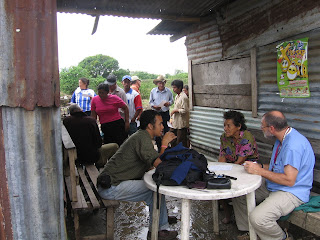
Well, where do we begin? It has certainly been a busy month since we last posted. In fact, we’ve been away from the office so much so that our old friend the keyboard currently feels a bit like a stranger. For the second and third weeks of November we traveled with a medical brigade from the States that was brought in to treat people affected by the storm; our role was to translate between English speaking doctors and nurses and Spanish speaking patients (that having been said, one of the doctors is more fluent than we are, another speaks enough to get by, and the others picked up a bit as time went on). We certainly saw a number of people who were affected by the storm, including people whose homes were flooded or destroyed and others whose crops were damaged, if not destroyed. As for the medical relevance of all this, many people we saw were dealing with colds, the flu, lack of access to clean water – and subsequently dehydration and water-borne illnesses – and different types of skin fungus, which may been caused or exacerbated by the moist conditions.

Dan translating


Although it may sound like sensationalism to include these next few observations, truly the purpose is to describe what daily life is like in many of the communities we’ve visited. One little girl we visited was sneezing up worms, which, fortunately, is easily treated. In another town, after we had already finished a full days work a young man in his twenties came to the home where we were staying, escorted by his elderly father; his hands were a mere mess of blood. The young man, who is right handed, had been cutting through something, which he held in his right hand, when the knife suddenly broke through the object he’d been cutting and immediately sliced deep into his ring, middle, and index fingers. It seems that the tendons in his middle and ring fingers were completely severed, for which he’ll need reparative surgery to fix. Fortunately one of the doctors in our group, an emergency room physician, was able to stitch up the man’s hand with the help of the other members of the team, at least stemming the blood and giving the young man an opportunity to seek further medical attention in the coming weeks and months. We also saw a number of patients with psychological problems, some of which stemmed from the flooding, others of which were perhaps exacerbated by the flooding, or were in fact unrelated to it. We spoke with people who suffered from depression and loneliness, at least one person who seemed to suffer from mental illness but had never received counseling, yet more people who had been victims of domestic violence or sexual abuse, and for many people the subtext to all of their hardships was that they had been displaced by the flooding, or at the least that their dwellings and livelihoods had been compromised by the storm.

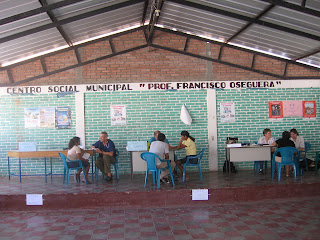
Emily to the right translating along with the Docs in "El Centro Social Municipal"


Many of the communities we visited were difficult to reach, leaving us bouncing around in the back of the truck with all the medical supplies during a rainstorm, but some of the villages were nearly impossible to reach, and had we not been there, they would not have received medical assistance. The main bridge of one community was washed out so we had to walk across a cable bridge, which the community had dubbed “la hamaca” or “the hammock” because of the way it swayed when people walked on it. This bridge was constructed with five heavy metal cables: two as railings to hold on to and three on the bottom. Community members had placed wooden boards across the three cables to walk upon, but in many places there were two or three boards in a row missing and the only option was to walk across the cable. Fortunately no one in the group was afraid of heights! Another community was inaccessible except by boat or walking waist-deep in water, so we, and all the medical supplies, were transported by boat. Life in the Peace Corps is typically a humbling experience but these past few weeks of working in a supportive capacity to this medical brigade and the people they’ve been treating has punctuated that sense of humility.

Traveling with two nurses and the medical supplies


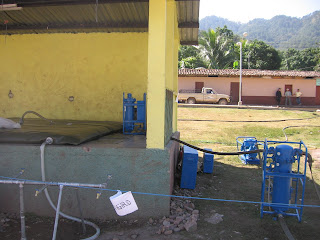
While Emily worked with the medical brigade for the entirety of two weeks, I was only there for a week and a half. For the latter half of the first week I helped translate for a British engineer who was flown in to help install two temporary water plants in communities whose water systems had been damaged during the storm. For anyone who has a knack for assembling and disassembling machines, and certainly for any engineers who read this I can say that it was interesting to be part of the process of installing these temporary water plants which are accompanied by 10,000 liter inflatable tanks. These water plants consist of three parts: a primitive crank start diesel powered pump which pulls water from a nearby source (a creek for instance), a filter which utilizes a series of probably 30 plastic tubes, approximately 1 cm x 40 cm, which, with the help of a fine powder constitute the first of a two part treatment process, and a third machine that dispenses chlorine in small quantities before the water finally arrives at the inflatable tank. These filters were last used in relief efforts for the Christmas tsunami of 2005. If I’m not mistaken, the filters were brought out of a warehouse somewhere in southeast Asia, put on an American Airlines jet and a week later were delivered to Honduras. Aside from marveling at the efficacy of this quick installation water treatment plant (it takes approximately 3 hours to install the system and educate someone on how to operate and maintain it), I’ve also learned a bit about the potential conflicts in marching into a community and introducing new technology without adequate preparation beforehand. While in one community we found people who were familiar enough with plumbing and water systems to quickly learn how to operate the system we were installing, in another community the people we were teaching how to operate the system didn’t have enough prior experience to feel comfortable operating the system without extensively repeating the lesson, which created a palpable sense of tension at times. Everyone involved was there of their own volition, to help, nothing more. Good intentions aside, I do wonder how might the installation have gone more smoothly – aren’t there always new lessons to learn?

The water system


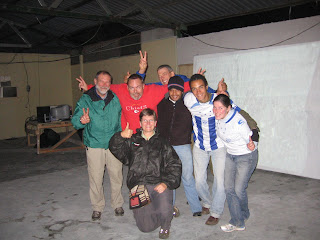
As far as major sporting events go in Honduras, the November 19th fútbol game against Mexico was as good as it gets. The game was to decide which teams would pass on to the next round of qualifying games for the 2010 World Cup and if Honduras lost, they would be eliminated. We, the doctors from the brigade, and another translator, went to a “sports pub” to watch the game projected onto a large wall. After a tense and cold (another cold front passed over Honduras last week and had us wearing fleeces and hats again) first half, the game was still 0-0. In the second half, Honduras scored a goal through a corner kick that went off the foot of one of the Mexican defenders. Honduras went on to win the game 1-0 and honking cars could be heard late into the night celebrating the country’s victory. We’re looking forward to the next round, which will start in February, and give us another occasion to wear our selección shirts.

Dave, John, Digger, Cathy (all Medical Teams International volunteers),

Daniel, Daniel and Emily (the translators)


Since ending our stint as traveling translators we’ve been back to one of our most practiced pastimes, home shopping. Despite our best efforts, the most promising homes we’ve seen thus far haven’t worked out, for a variety of reasons. As we imagine we’re preaching to the choir here, we’ll keep this relatively short; when home shopping, it seems the whole trick to the game is to get back on the proverbial pony and just keep going, even when you’re sick of being shown that repugnant pink house time and again. It would make sense to mention that there’s no “official” process by which people search for homes here in Siguatepeque. The objective is to wander the streets in neighborhoods which you like, asking anyone who seems potentially knowledgeable about the housing market whether they know of anyone who is renting a home (interestingly, the only group excluded from our canvassing effort is the 5 years and under crowd). Our favorite strategy is to speak with the owners of corner stores, known as pulperias, and launch into our routine, “Disculpe (Señor, Señora, Don, Doña), andamos buscando una casita con dos cuartos, una cocina, un baño, y poco terreno. ¿Sabe si alguien está alquilando una casa en este barrio?” Finding a home with two rooms, a kitchen, a bathroom, and a little bit of land has proven to be a challenge, no doubt. However, as Queen’s Freddy Mercury so famously belted all those years ago, the show must go on. Wish as luck, if you will.

A few days ago, we celebrated Thanksgiving with a couple of friends in the department of Santa Barbara. Jessica and Brenna had already started on dinner when we got there on Thursday around noon, so we ate lunch with them and got back to cooking. When it was all said and done, dinner consisted of a baked chicken, green beans, stuffing, mashed potatoes, pumpkin pie, and wheat rolls (all from scratch). We also enjoyed a bit of wine during the cooking process and with dinner. We hope you all had a wonderful Thanksgiving and were blessed with friends, family and a great meal. ¡Hasta la proxima vez!

Thanksgiving dinner...yum!

Jessica, Brenna, and Dan eating on the deck

Tuesday, November 4, 2008

¡Tenemos hormigas en nuestros pantalones!

As you´re already aware if you´ve read our last blog or followed more obscure bits of international news, we´ve had a lot of rain here recently, so much so that many regions of the country are experiencing a disaster. Countless communities are still flooded, and as a cold front is moving through much of the country, many people who were staying with relatives or in shelters and struggling to find food may also now find themselves trying to fight off the cold. We´ve certainly been trying to help out through the large scale relief effort our counterpart organization is undertaking. At the same time, the word disaster signifies that the scale of the problem is beyond any immediate sweeping solution, short of the storm ceasing and the sun returning from its nearly month-long hiatus. Perhaps what´s most worrisome is that we have another month of eligibility left in the hurricane season and well-respected people who have lived here for quite a while are whispering about similarities between some of the damage already caused by this storm and that which was caused by the exceptionally devastating Hurricane Mitch almost exactly 10 years ago. That having been said, fortunately the country learned many lessons from Mitch and the loss of life is substantially lower this time around, not to mention this storm, which is not a hurricane, has been less devastating due to its slow, albeit steady progression. There´s not much left to say aside from the fact that we, along with hundreds if not thousands of others will keep chipping away at the stone, hoping that the rain will subside.

If you didn´t catch the meaning of this blog´s title, it´s “We have ants in our pants!” So what about those ants, anyhow, and how might they relate to the storm we’ve been experiencing? As any amateur biologist – by this I mean relatively observant human – already knows, when the weather´s miserable, most creatures like to find the safest shelter around. By the dozens, ants have decided that our room is a likely shelter. I don´t want to misquote Benjamin Franklin, but as I´m writing this I have no way to check; as I believe Franklin once mused, “Guests are like fish, they stink after two days”. That sentiment is magnified when the guests arrive by the dozens, unannounced, and stay for weeks on end. The worst part of it all is that, tenemos hormigas en nuestros pantalones! No, we´re not looking for a cliché to say that we have cabin fever; nearly every morning we find that we have dozens of ants in our pants, although occasionally they´re tucked into a shirt instead. I guess it´s sensible that they too want a warm sheltered environment to hunker down, although, in its own special way the garbage can is also a warm sheltered environment, with all of its Kleenex and wrapper insulation – one has to wonder why they aren´t there, with the free crumbs and all. Regardless, our morning routine now has an additional step: 1.) hit the snooze once or twice, 2.) wash face, brush teeth, shave, etc. 3.) shake half-inch ants out of pants, 4.) breakfast and begin our walking commute. We hope you noted the size of these ants. When they fall from our pants to the floor they actually make an audible thud and then scurry away to find another garment to hide in. At first we were fighting them, sweeping them out with a broom, but they just keep coming back, so we have resigned ourselves to their presence until the storm is over.

Speaking of cold and rainy weather, what would you guess the temperature is here if we told you that we´re walking around with flannels, fleeces, and winter hats on? 18 degrees C = approximately 64 degrees F, which for us amounts to a cold streak. If it weren´t for a lifetime of schooling and logical thought to influence us, we just might be looking up at the sky, waiting for the snow to begin falling. It´s safe to say we`ve acclimated to the warmer climate here. And if you´re curious, yes, the showers are as cold as ever =)

Thinking about snow is enough to make us break our 3-cups-a-day rule. Because we´re in a coffee growing area, it is a sign of hospitality to offer a cup of coffee to guests and it would be quite impolite to refuse. Subsequently, we are often drinking 3 or more cups of coffee each day, regardless of the fact that we didn´t even drink coffee in the States. Fortunately, the coffee here is excellent, though I think we´ll be returning to the States with a caffeine addiction we didn´t have before.

On Sunday, we ventured out (all bundled up, of course) to the cemetery and experienced Siguatepeque`s way of honoring the dead on “Día de los Muertos”. While in Mexico, “Día de los Muertos” is a day when families go to the cemetery to picnic with their deceased relatives (eating the food that their family member most liked, and drinking on their behalf if they were a drinker in life), here in Siguat the celebration resembles Memorial Day in the States. Many families come to clean and lay beautiful tropical-flower-bouquets on the graves.

Take care, and stay in touch.

Thursday, October 23, 2008

Relief Work

Due to not having internet access for the past few days, all our devoted fans (our parents) will receive two blog posts in one day. If you have a passion for watching international weather news, you may know that the quantity of rain Honduras has received in the past week has caused massive flooding in many parts of the country. Fortunately for us, Siguatepeque has not been subject to this flooding. However, since we work for Aldea Global, we have been able to help in some of the relief work to communities that are suffering from flooding.

Yesterday, when we got to work, we attended a planning meeting right away because Aldea Global had received a request for help. As we made a list of all the things we could provide this community, Dan (with his background in Natural Hazard Mitigation) suggested that water would be of the utmost importance for this community. We next started brainstorming about where we could get filtered water for free. We remembered that CEASO, an integrated farm we visited during training, has a large tank of filtered water (runoff from their roof that passes through a carbon filter into a 2,800 gallon tank) that we would be welcome to use. So, Aldea Global rounded up every empty receptacle that could be used to carry water and off we went to CEASO. Because the truck was needed for something else, Dan and I got dropped off with all the empty bottles (each ranging from 2.5-5 gallon capacity). As it started raining again, we came up with a system to fill and transport the bottles to where they could be loaded back into a truck. When it was all said and done, we contributed over 100 gallons of water through collaboration with this other organization.

While we were filling up water bottles, other members of the Aldea Global team were buying more water, gathering up medical supplies, and generally getting everything organized for us to head out. We then traveled to a large warehouse where blankets, canned turkey, anti-bacterial soap, and all sorts of other emergency supplies are housed. Everyone formed a human chain as we passed boxes into a large truck for delivery. Once we were all completely drenched with sweat, and the truck was full, we headed to the small aldea (village) that had requested our help. At first when we got there, the situation did not appear as bad as we had expected, but once the trucks were all parked, we got out and walked around the corner. Fortunately, we were wearing our rubber boots, because we were soon standing in over a foot of water and by the water-marks on the houses, we could see that the water had been waist-high.

We handed out water to the families in this small community while other members of Aldea Global unloaded other supplies from the large truck. When the day was over, our arms and backs were a bit tired from our day of carrying water jugs, boxes, and bags filled with blankets. However, we were glad to contribute in our small way to those affected by the storm.

Cheerful in our tropical depression

Our reactions were mixed when we learned early last week that we were in the midst of a tropical depression. At first we just resigned ourselves to being drenched for an indeterminate amount of time from the persistent rains. Then, during one of the many afternoons we spent holed up inside Emily suggested that “tropical depression” need not only be a weather phenomenon that limited our mobility. Why, it could be the name of our very own tasty tropical beverage – meet the tropical depression! We`ll let you know how it tastes when it debuts. For now, we´re just stuck inside dreaming of tropical depressions, the tasty variety that is.

In all fairness, “stuck inside” isn´t an entirely fair characterization of what we´re up to these days. We`re still traveling and attending meetings with our counterparts, albeit on a limited basis due to the many floods plaguing the country. Emily is currently engaged in a few health initiatives ranging from HIV/AIDS support to self esteem development, and I´m principally a laborer, helping transport a few thousand trees a few times a week to support a reforestation initiative in our park. There´s nothing like carrying plants and pushing a wheelbarrow for hours on end to remind me I´m in good, but not great shape. Ultimately, as is the experience of most volunteers early in their service, we´re busiest getting acquainted with our community, the language, and what we may be doing in the future rather than actually “working” much in any traditional sense, although I think we´re contributing a bit. Let that be the context for this anecdote. A successful day may look something like this: a fellow volunteer who is helping form a cooperative of female hammock makers sent us an email with an enticing offer to have a hammock made in the colors of our alma mater (go Ducks!) for an affordable price, and in time for the holidays at that. Finding a hammock is, in and of itself, enough to polish the day.

We´re still living with our host family and enjoying their company. Game nights are especially fun as we get to watch the Honduras national team (La Selección) play against other teams for a spot in the world cup. Our mom is a consummate good hostess and makes sure we have soda and popcorn for each game – tasty! As is the case with many sporting events the world over, it´s encouraging to watch the entire country unite behind the national team, in spite of the many conflicts that may be barriers to communication on other days. More than a few times we´ve heard that wearing the jersey of La Selección on game day is virtually a free pass to travel anywhere in the country without incident, including areas that are traditionally dangerous even for Hondurans. Of course we´d not be interested to test this theory, but the unifying element of fútbol here in Honduras cannot be easily overstated.

As a fun way to wrap this up we´ll share a few recent experiences that have already become normal to us, but that would have been anything but when we first arrived to Honduras a few months ago. Two weeks ago we were sitting in some makeshift bleachers at the local cancha de fútbol when a horse entered the field from an adjacent dirt road, crossed the field at full gallop (we clearly heard the pounding of its hooves from 100 meters away), jumped a ditch, and continued down a road on the other side of the field, still at full gallop. Oh well, we thought, these things happen. Just the other morning when we were on our way to work in our botas de goma (knee high gum/rain boots), sombreros, and raincoats – our normal garb these days – Emily interrupted me in mid story to point out a potential perro bravo that was suspiciously eying all passersby. ¿What did we do, you ask? Well, of course we walked through the foot deep puddles in the ditch on the other side of the road to evade a sticky situation. If it comes down to it I´ve discovered I myself have a pretty intimidating bark, and we´re both capable of tossing a few rocks, although we`re definitely honing our sixth sense for problematic dogs to avoid having to exercise our own animal instincts. Last but not least, we´ve discovered that cold showers are downright intimidating when the weather´s rainy and chilly, but one must bathe. While we grow braver with each shower, I think we´ll always have a soft spot for hot water heaters and that precious commodity they produce! If you have hot water, enjoy a nice shower for us, would ya =)

As always, we hope you´re doing well. Please drop us a line when you get the chance.

-Em and Dan